
Join Our JEE Preparation Group
Prep with like-minded aspirants; Get access to free daily tests and study material.
Sign in
Please select an account to continue using cracku.in
↓ →
Join Our JEE Preparation Group
Prep with like-minded aspirants; Get access to free daily tests and study material.
The total number of chiral compound/s from the following is
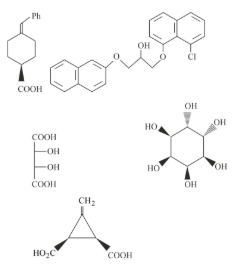
Correct Answer: 2
For every compound, we have to perform two routine checks.
1. Does the molecule contain at least one $$\text{sp}^3$$-hybridised carbon attached to four different groups? Such a carbon is called a stereogenic (or chiral) centre.
2. If a stereogenic centre is present, does the whole molecule possess an element of symmetry (a mirror plane or a centre of inversion) that converts the presumed “left” hand into the “right” hand? If such a symmetry element is present, the molecule is achiral (it may be meso); if not, the molecule is chiral.
Case 1: first compound - it has no $$\text{sp}^3$$ carbon bonded to four different groups, so there is no stereogenic centre. Hence the first compound is achiral.
Case 2: second compound - the highlighted carbon bears four different groups. No internal mirror plane or inversion centre exists because every substituent on that carbon is different. Therefore the second compound is chiral and can exist as a pair of enantiomers.
Case 3: third compound - although two adjacent $$\text{sp}^3$$ carbons are each attached to four different groups, the overall molecule has a mirror plane that bisects the C-C bond joining those two centres. The left half of the molecule reflects perfectly onto the right half, so the entire structure is a meso form. Consequently the third compound is achiral.
Case 4: fourth compound - it contains one stereogenic carbon with four different groups and no symmetry element that can superpose the molecule on its mirror image. Hence the fourth compound is chiral.
Only the second and the fourth compounds satisfy both requirements simultaneously, so they are the only chiral members of the given set.
Therefore, the total number of chiral compounds is 2.
Was this solution helpful?
_1.webp)

Educational materials for JEE preparation

Ask our AI anything

AI can make mistakes. Please verify important information.
AI can make mistakes. Please verify important information.