
Join Our JEE Preparation Group
Prep with like-minded aspirants; Get access to free daily tests and study material.
Sign in
Please select an account to continue using cracku.in
↓ →
Join Our JEE Preparation Group
Prep with like-minded aspirants; Get access to free daily tests and study material.
For a coordination number $$4$$, two common geometries are possible: square-planar (hybridisation $$dsp^2$$) and tetrahedral (hybridisation $$sp^3$$).
The actual geometry depends mainly on (i) metal ion electronic configuration, (ii) its period (3d, 4d, 5d) and (iii) ligand field strength.
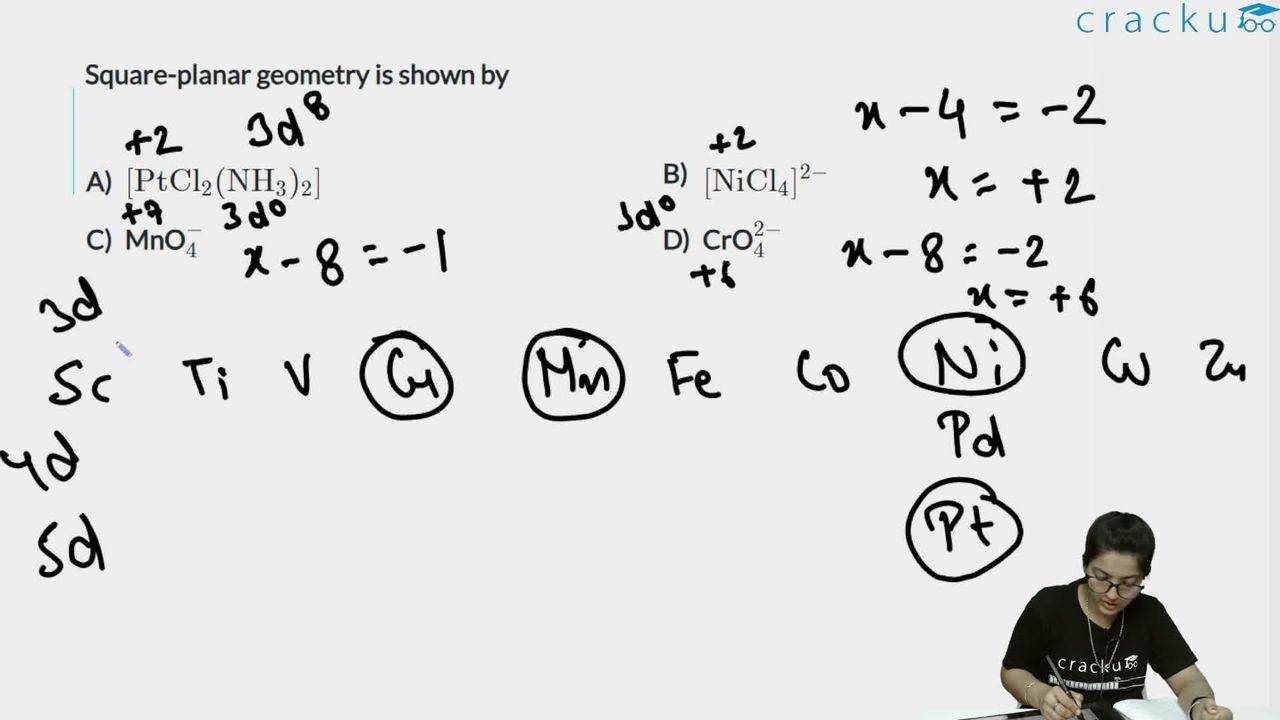
Option A: $$[\text{PtCl}_2(\text{NH}_3)_2]$$
Platinum in this complex is in the $$+2$$ oxidation state, so $$\text{Pt}^{2+}$$ has the electronic configuration $$[Xe]4f^{14}5d^8$$ (a 5d$$^8$$ system).
For 4d and 5d metals with $$d^8$$ configuration, the pairing energy is small compared to the crystal-field splitting produced by even moderate ligands like $$\text{Cl}^-$$/$$\text{NH}_3$$. Hence all eight d-electrons pair up in the lower set of orbitals, leaving one empty $$d_{x^2-y^2}$$ orbital to participate in $$dsp^2$$ hybridisation:
$$d_{x^2-y^2} + s + p_x + p_y \;\longrightarrow\; dsp^2$$ hybrid orbitals
The four $$dsp^2$$ hybrids lie in one plane, 90° apart, giving a square-planar geometry. Therefore Option A is square-planar.
Option B: $$[\text{NiCl}_4]^{2-}$$
Nickel is in the $$+2$$ state: $$\text{Ni}^{2+}: [Ar]3d^8$$. For 3d metals the crystal-field splitting is smaller and the pairing energy is relatively high. Chloride is also a weak-field ligand. Hence electrons remain unpaired and the complex uses $$sp^3$$ hybridisation, producing a tetrahedral geometry. So this option is NOT square-planar.
Option C: $$\text{MnO}_4^-$$ (permanganate ion)
In $$\text{MnO}_4^-$$, manganese is in the $$+7$$ oxidation state and is tetrahedrally surrounded by four oxide ligands through $$p\pi-d\pi$$ bonding. The species is not a coordination complex with central-metal hybridisation like $$dsp^2$$; its shape is tetrahedral. Hence not square-planar.
Option D: $$\text{CrO}_4^{2-}$$ (chromate ion)
Similarly, $$\text{CrO}_4^{2-}$$ contains chromium in the $$+6$$ state with four oxide ligands arranged tetrahedrally. Therefore this ion also is not square-planar.
Thus, among the given species, only Option A exhibits square-planar geometry.
Answer: Option A which is: $$[\text{PtCl}_2(\text{NH}_3)_2]$$
Was this solution helpful?
Click on the Email ☝️ to Watch the Video Solution
Create a FREE account and get:
Educational materials for JEE preparation

Ask our AI anything

AI can make mistakes. Please verify important information.
AI can make mistakes. Please verify important information.

_1.webp)
