Join Our JEE Preparation Group
Prep with like-minded aspirants; Get access to free daily tests and study material.
Sign in
Please select an account to continue using cracku.in
↓ →
Join Our JEE Preparation Group
Prep with like-minded aspirants; Get access to free daily tests and study material.
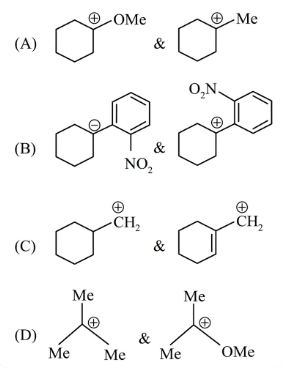
To determine which pairs have the first carbocation more stable than the second, we must compare the factors affecting carbocation stability in each case.
For Pair (A):
The first carbocation has its positive charge adjacent to a methoxy group $$(-OMe)$$. The oxygen atom possesses lone pairs that can be donated into the empty $$p$$-orbital of the carbocation through resonance, exhibiting a strong $$+M$$ effect. This resonance generates an oxonium ion structure in which the carbocation attains a complete octet, providing significant stabilization.
The second carbocation is a tertiary carbocation stabilized mainly by the $$+I$$ effect and hyperconjugation from the adjacent alkyl groups.
Since resonance stabilization that completes the octet is much stronger than hyperconjugation, the first carbocation is more stable than the second.
Hence, Pair (A) satisfies the given condition.
For Pair (B):
In the second carbocation, the nitro group $$(-NO_2)$$ is present at the para position and remains coplanar with the benzene ring. Therefore, it exerts its full $$-M$$ (resonance withdrawing) effect, strongly destabilizing the positive charge.
In the first carbocation, the nitro group is at the ortho position, while the carbocation-bearing carbon is attached to a bulky cyclohexyl group. Steric repulsion between these groups forces the nitro group out of the plane of the aromatic ring. As a result, resonance between the nitro group and the ring is inhibited, a phenomenon known as Steric Inhibition of Resonance (SIR).
Because the $$-M$$ effect is largely suppressed, only the weaker $$-I$$ effect operates, making the first carbocation comparatively more stable than the second.
Hence, Pair (B) also satisfies the given condition.
For Pair (C):
The first structure is an ordinary primary carbocation attached to a saturated cyclohexane ring.
The second structure is a primary carbocation adjacent to a cyclohexene system. The nearby double bond can stabilize the positive charge through homoallylic participation involving the $$\pi$$ electrons, giving additional stabilization.
Therefore, the second carbocation is more stable than the first, so this pair does not satisfy the required condition.
For Pair (D):
The first carbocation is a tert-butyl carbocation stabilized by hyperconjugation.
The second carbocation has a methoxy group adjacent to the positively charged carbon. The oxygen atom donates its lone pair through resonance ($$+M$$ effect), producing an octet-complete resonance structure and greatly stabilizing the carbocation.
Consequently, the second carbocation is much more stable than the first.
Therefore, this pair also does not satisfy the required condition.
Hence, the pairs in which the first carbocation is more stable than the second are (A) and (B) only.
Therefore, the correct answer is (A) & (B) only.
Was this solution helpful?
Create a FREE account and get:
_1.webp)

Educational materials for JEE preparation

Ask our AI anything

AI can make mistakes. Please verify important information.
AI can make mistakes. Please verify important information.