
Join Our JEE Preparation Group
Prep with like-minded aspirants; Get access to free daily tests and study material.
Sign in
Please select an account to continue using cracku.in
↓ →
Join Our JEE Preparation Group
Prep with like-minded aspirants; Get access to free daily tests and study material.
A dipeptide, "x" on complete hydrolysis gives "y" and "z". "y" on treatment with aq. HNO$$_2$$ produces lactic acid. On the other hand "z" on heating gives a cyclic molecule.
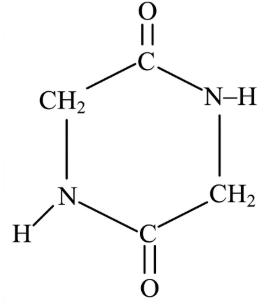
Based on the information given, the dipeptide X is:
To determine the correct dipeptide X, we first identify the amino acids Y and Z obtained on hydrolysis.
The first clue states that amino acid Y produces lactic acid on treatment with aqueous $$\mathrm{HNO_2}$$.
Nitrous acid converts the primary amino group $$\left(-NH_2\right)$$ of an aliphatic amino acid into a hydroxyl group $$\left(-OH\right)$$.
Since the product formed is lactic acid,
$$\mathrm{CH_3-CH(OH)-COOH},$$
the original amino acid must have been
$$\mathrm{CH_3-CH(NH_2)-COOH},$$
which is alanine.
Hence,
The second clue states that amino acid Z forms the given cyclic compound on heating.
When $$\alpha$$-amino acids are heated, two molecules condense to form a six-membered cyclic diamide known as a diketopiperazine.
From the structure of the cyclic product, the carbon atoms between the nitrogen and carbonyl groups are simple $$CH_2$$ units with no alkyl substituents.
This is possible only if the amino acid is glycine,
$$\mathrm{H_2N-CH_2-COOH}.$$
Therefore,
The required dipeptide X is obtained by condensation of alanine and glycine.
Hence,
Therefore, the correct answer is Alanine-Glycine.
Was this solution helpful?
Create a FREE account and get:
_1.webp)

Educational materials for JEE preparation

Ask our AI anything

AI can make mistakes. Please verify important information.
AI can make mistakes. Please verify important information.
