
Join Our JEE Preparation Group
Prep with like-minded aspirants; Get access to free daily tests and study material.
Sign in
Please select an account to continue using cracku.in
↓ →
Join Our JEE Preparation Group
Prep with like-minded aspirants; Get access to free daily tests and study material.
Given below are two statements :
Statement (I) : Alcohols are formed when alkyl chlorides are treated with aqueous potassium hydroxide by elimination reaction.
Statement (II) : In alcoholic potassium hydroxide, alkyl chlorides form alkenes by abstracting the hydrogen from the $$\beta$$-carbon.
In the light of the above statements, choose the most appropriate answer from the option given below :
The behaviour of alkyl halides changes with the nature of the $$KOH$$ medium.
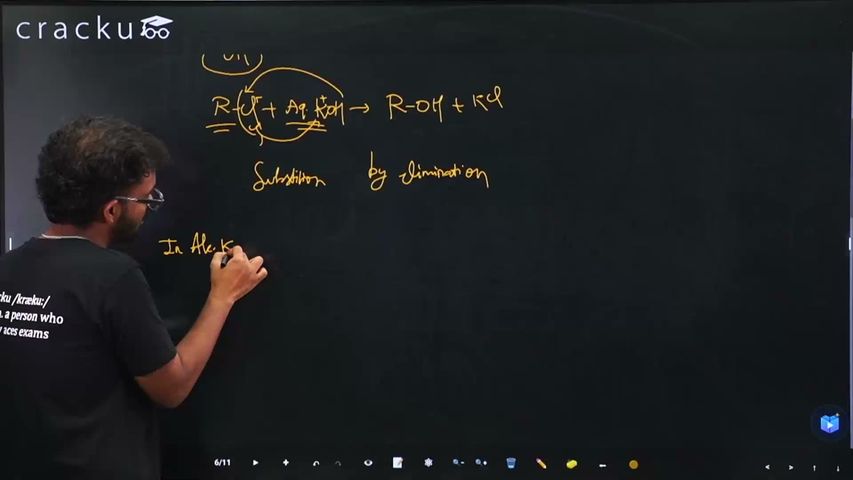
Case 1: Aqueous $$KOH$$ reacts with alkyl chlorides mainly through nucleophilic substitution ($$S_{N1}$$ or $$S_{N2}$$).
• The hydroxide ion $$OH^-$$ attacks the carbon bearing the chlorine and replaces $$Cl^-$$.
• This produces an alcohol: $$R{-}Cl + KOH_{(aq)} \rightarrow R{-}OH + KCl$$.
• The mechanism is substitution, not elimination.
Therefore Statement (I) is incorrect because it labels the reaction as “elimination” instead of “substitution.”
Case 2: Alcoholic $$KOH$$ behaves as a strong base rather than a nucleophile.
• The ethoxide/alkoxide ion ($$RO^-$$ formed in situ) abstracts a hydrogen from a $$\beta$$-carbon (carbon adjacent to the one carrying $$Cl$$).
• Simultaneously the $$Cl^-$$ leaves, giving an alkene: $$R{-}CH_2{-}CH_2Cl \xrightarrow[KOH_{(alc)}]{} R{-}CH{=}CH_2 + KCl + H_2O$$.
• This is an elimination (E2/E1) reaction, exactly as described in Statement (II).
Hence Statement (II) is correct.
Combining the conclusions:
• Statement (I) - Incorrect.
• Statement (II) - Correct.
Thus the most appropriate choice is Option B.
Was this solution helpful?
Click on the Email ☝️ to Watch the Video Solution
Create a FREE account and get:
_1.webp)

Educational materials for JEE preparation

Ask our AI anything

AI can make mistakes. Please verify important information.
AI can make mistakes. Please verify important information.
