
Join Our JEE Preparation Group
Prep with like-minded aspirants; Get access to free daily tests and study material.
Sign in
Please select an account to continue using cracku.in
↓ →
Join Our JEE Preparation Group
Prep with like-minded aspirants; Get access to free daily tests and study material.
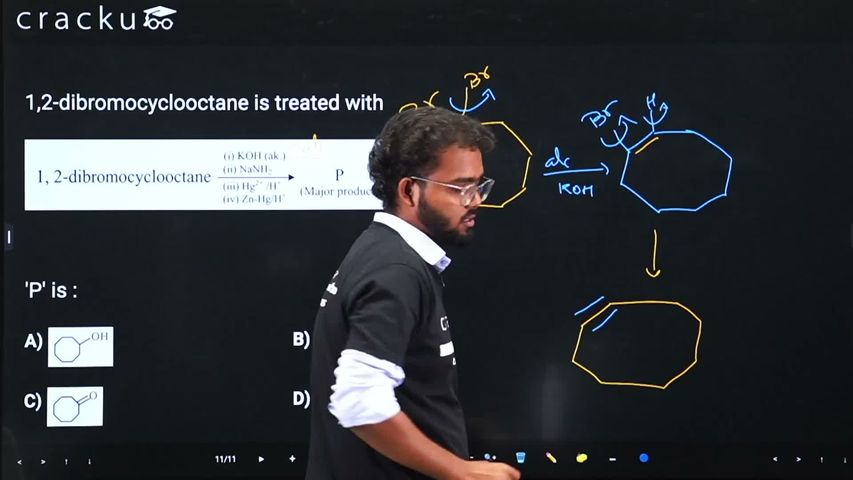
To determine the major product P, we analyze each step of the reaction sequence systematically.
The first two steps involve the conversion of 1,2-dibromocyclooctane into an alkyne. Treatment with aqueous $$KOH$$ initially causes dehydrohalogenation to form a vinyl bromide, and the subsequent treatment with the strong base $$NaNH_2$$ removes another molecule of $$HBr$$ to produce cyclooctyne through double dehydrohalogenation.
In the third step, cyclooctyne is treated with $$Hg^{2+}/H^+$$. Under these conditions, the alkyne undergoes acid-catalyzed hydration to form an enol, which rapidly tautomerizes to the corresponding ketone. Thus, cyclooctyne is converted into cyclooctanone.
In the final step, cyclooctanone is subjected to Clemmensen reduction using $$Zn\text{-}Hg/H^+$$. The carbonyl group is completely reduced to a methylene group $$(-CH_2-)$$, converting the ketone into the corresponding saturated hydrocarbon.
Therefore, the overall transformation is
$$\text{1,2-dibromocyclooctane} ;\longrightarrow; \text{cyclooctyne} ;\longrightarrow; \text{cyclooctanone} ;\longrightarrow; \text{cyclooctane}.$$
Hence, the final major product P is cyclooctane, corresponding to the eight-membered saturated ring shown in option B
Was this solution helpful?
Click on the Email ☝️ to Watch the Video Solution
Create a FREE account and get:
_1.webp)

Educational materials for JEE preparation

Ask our AI anything

AI can make mistakes. Please verify important information.
AI can make mistakes. Please verify important information.

