Join Our JEE Preparation Group
Prep with like-minded aspirants; Get access to free daily tests and study material.
Sign in
Please select an account to continue using cracku.in
↓ →
Join Our JEE Preparation Group
Prep with like-minded aspirants; Get access to free daily tests and study material.
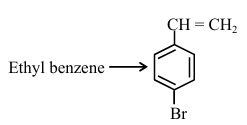
To convert ethylbenzene into 4-bromostyrene, the reaction sequence must involve aromatic bromination, side-chain halogenation, and dehydrohalogenation.
The first step is electrophilic aromatic bromination using $$Br_2/Fe$$. In the presence of iron, $$Br_2$$ generates the electrophile required for bromination. Since the ethyl group is an ortho/para-directing substituent, bromination occurs predominantly at the para position, producing 4-bromoethylbenzene.
The second step is free radical side-chain chlorination using $$Cl_2$$ under heat $$\left(\Delta\right)$$. Under these conditions, substitution occurs preferentially at the benzylic carbon, yielding 1-chloro-1-(4-bromophenyl)ethane.
The final step involves treatment with alcoholic $$KOH$$, which promotes an $$E2$$ dehydrohalogenation reaction. Elimination of $$HCl$$ from the benzylic chloride forms a carbon-carbon double bond, producing 4-bromostyrene.
Thus, the correct sequence of reagents is
$$Br_2/Fe \longrightarrow; Cl_2,\Delta \longrightarrow; \text{alc. }KOH.$$
Hence, the correct answer is
$$Br_2/Fe Cl_2,\Delta \text{alc. }KOH.$$
This corresponds to option A.
Was this solution helpful?
Click on the Email ☝️ to Watch the Video Solution
Create a FREE account and get:
_1.webp)

Educational materials for JEE preparation

Ask our AI anything

AI can make mistakes. Please verify important information.
AI can make mistakes. Please verify important information.