Join Our JEE Preparation Group
Prep with like-minded aspirants; Get access to free daily tests and study material.
Sign in
Please select an account to continue using cracku.in
↓ →
Join Our JEE Preparation Group
Prep with like-minded aspirants; Get access to free daily tests and study material.
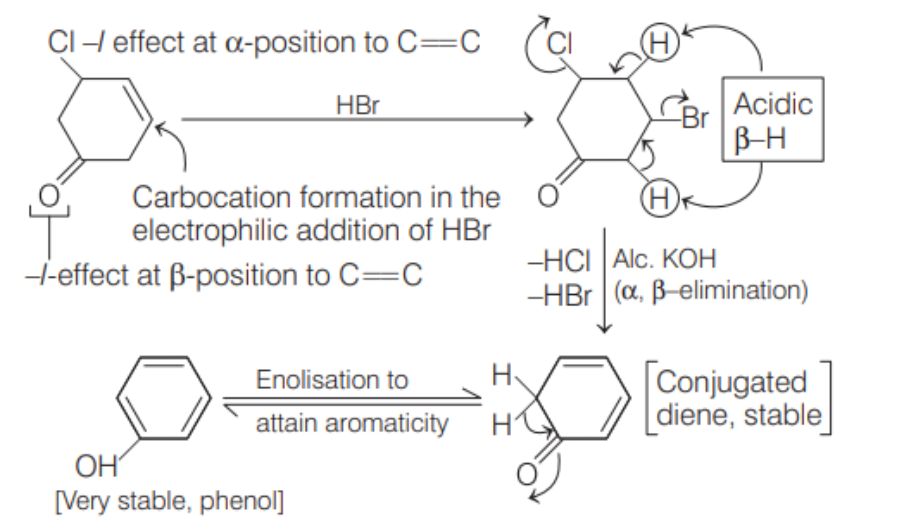
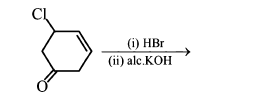
Step 1: Base-Mediated Dehydrohalogenation ($$\alpha,\beta$$-Elimination)
The reaction begins with the elimination of hydrogen bromide ($$-\text{HBr}$$) from the cyclic bromo-ketone precursor. A base abstracts a proton from the $$\beta$$-position relative to the leaving group ($$\text{--Br}$$), triggering an $$\alpha,\beta$$-elimination that forms a stable, conjugated diene intermediate (a cyclohexadienone derivative):
$$\text{Bromo-ketone Precursor} \xrightarrow{-\text{HBr}} \text{Cyclohexadienone Intermediate [Conjugated diene, stable]}$$Step 2: Tautomerization (Enolisation to Attain Aromaticity)
The non-aromatic cyclohexadienone intermediate contains a highly acidic sp3 hybridized carbon bearing two hydrogen atoms adjacent to the carbonyl group ($$\text{C=O}$$). To relieve ring strain and gain immense thermodynamic stability, the compound undergoes rapid enolisation (keto-enol tautomerization). This restores the fully delocalized $$\pi$$-system of the benzene ring:
$$\text{Cyclohexadienone (Keto form)} \rightleftharpoons \text{Phenol Derivative (Enol form) [Very stable, aromatic]}$$The driving force of the entire transformation is the immense resonance energy gained through aromatization, shifting the equilibrium completely toward the formation of the phenol derivative.
Answer: The option displaying the fully aromatic phenol derivative as the major product (Option B).
Was this solution helpful?
Create a FREE account and get:
_1.webp)

Educational materials for JEE preparation

Ask our AI anything

AI can make mistakes. Please verify important information.
AI can make mistakes. Please verify important information.