
Join Our JEE Preparation Group
Prep with like-minded aspirants; Get access to free daily tests and study material.
Sign in
Please select an account to continue using cracku.in
↓ →
Join Our JEE Preparation Group
Prep with like-minded aspirants; Get access to free daily tests and study material.
Match List - I with List - II.
Given $$V_1$$ and $$V_2$$ are initial and final volumes respectively.
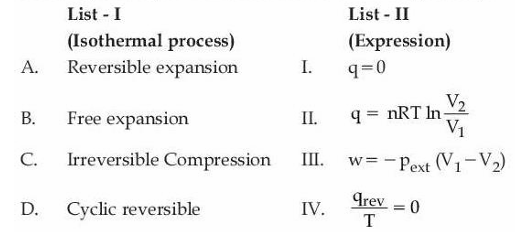
Choose the correct answer from the options given below :
The thermodynamic expressions for each process can be obtained using the first law of thermodynamics and the properties of ideal gases.
For a reversible isothermal expansion of an ideal gas, the temperature remains constant, so the change in internal energy is zero.
$$\Delta U=0.$$
From the first law,
$$\Delta U=q+w,$$
which gives
$$q=-w.$$
The work done in a reversible isothermal expansion is
$$w=-nRT\ln\left(\frac{V_2}{V_1}\right).$$
Hence,
$$q=nRT\ln\left(\frac{V_2}{V_1}\right),$$
so A matches II.
In free expansion, the gas expands against zero external pressure ((P_{\text{ext}}=0)). Therefore,
$$w=0.$$
Since the process is isothermal for an ideal gas,
$$\Delta U=0,$$
and from the first law,
$$q=0.$$
Hence, B matches I.
For an irreversible compression against a constant external pressure, the work done is given by
$$w=-P_{\text{ext}}(V_2-V_1).$$
Thus, C matches III.
In a cyclic reversible process, the system returns to its initial state. Since entropy is a state function, the net change in entropy over one complete cycle is zero.
$$\Delta S=\oint\frac{dq_{\text{rev}}}{T}=0.$$
Hence, D matches IV.
Therefore, the correct matching is
Hence, the correct answer is A-II, B-I, C-III, D-IV.
Was this solution helpful?
Create a FREE account and get:
_1.webp)

Educational materials for JEE preparation

Ask our AI anything

AI can make mistakes. Please verify important information.
AI can make mistakes. Please verify important information.
