
Join Our JEE Preparation Group
Prep with like-minded aspirants; Get access to free daily tests and study material.
Sign in
Please select an account to continue using cracku.in
↓ →
Join Our JEE Preparation Group
Prep with like-minded aspirants; Get access to free daily tests and study material.
Given below are two statements :
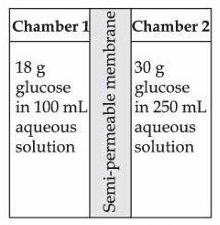
Statement I : H$$_2$$O molecules move from the chamber 1 to chamber 2.
Statement II : The osmotic pressure of a solution prepared by dissolving 50 mg of potassium sulphate (molar mass = 174 g/mol) in 2 L of water (at 27 °C) is 0.0107 bar. (Given: R = 0.083 dm$$^3$$ bar K$$^{-1}$$ mol$$^{-1}$$ and assume complete dissociation of electrolyte)
In the light of the above statements, choose the correct answer from the options given below :
For osmosis to occur, solvent molecules move through a semipermeable membrane from a region of lower solute concentration to a region of higher solute concentration.
For Chamber 1,
$$\text{Concentration}=\frac{18\text{ g}/180\text{ g mol}^{-1}}{0.1\text{ L}}=\frac{0.1}{0.1}=1.0\text{ M}.$$
For Chamber 2,
$$\text{Concentration}=\frac{30\text{ g}/180\text{ g mol}^{-1}}{0.25\text{ L}}=\frac{0.166}{0.25}\approx0.66\text{ M}.$$
Since Chamber 1 has the higher solute concentration, water moves from Chamber 2 to Chamber 1. Therefore, the statement that water moves from Chamber 1 to Chamber 2 is false.
For the second statement, the osmotic pressure is calculated using
$$\pi=iCRT.$$
For (K_2SO_4),
$$K_2SO_4\rightarrow2K^++SO_4^{2-},$$
so
$$i=3.$$
The number of moles of (K_2SO_4) is
$$\frac{0.05}{174}=2.87\times10^{-4}\text{ mol}.$$
Hence, the concentration is
$$C=\frac{2.87\times10^{-4}}{2}=1.437\times10^{-4}\text{ M}.$$
Substituting into the osmotic pressure equation,
$$\pi=3\times(1.437\times10^{-4})\times0.083\times300\approx0.0107\text{ bar}.$$
Therefore, Statement II is true.
Hence, Statement I is false and Statement II is true. Therefore, the correct answer is Option D.
Was this solution helpful?
Create a FREE account and get:
_1.webp)

Educational materials for JEE preparation

Ask our AI anything

AI can make mistakes. Please verify important information.
AI can make mistakes. Please verify important information.
