
Join Our JEE Preparation Group
Prep with like-minded aspirants; Get access to free daily tests and study material.
Sign in
Please select an account to continue using cracku.in
↓ →
Join Our JEE Preparation Group
Prep with like-minded aspirants; Get access to free daily tests and study material.
Given is a concentrated solution of a weak electrolyte $$A_xB_y$$ of concentration 'c' and dissociation constant 'K'. The degree of dissociation is given by :
Consider the dissociation equilibrium of the weak electrolyte
$$A_xB_y\rightleftharpoons xA^{y+}+yB^{x-}.$$
Let the initial concentration of the electrolyte be (c) and its degree of dissociation be (\alpha).
At equilibrium,
$$[A_xB_y]=c(1-\alpha),$$
$$[A^{y+}]=xc\alpha,$$
$$[B^{x-}]=yc\alpha.$$
The dissociation constant is
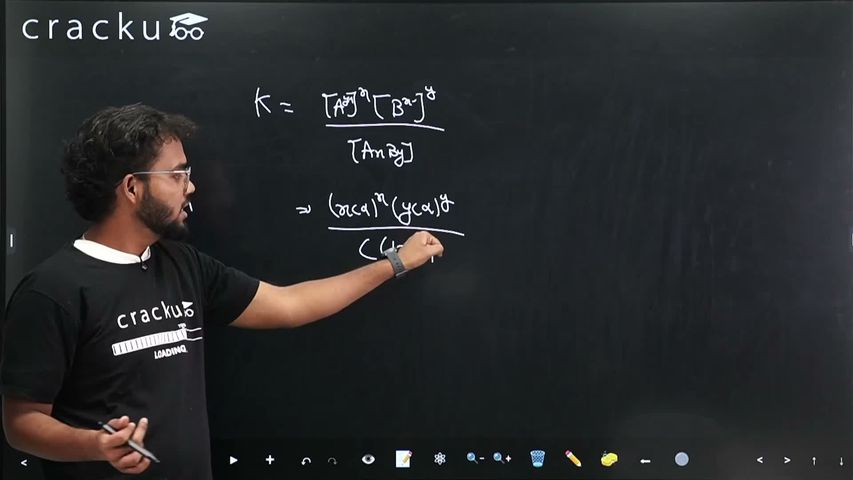
$$K=\frac{[A^{y+}]^x[B^{x-}]^y}{[A_xB_y]}.$$
Substituting the equilibrium concentrations,
$$K=\frac{(xc\alpha)^x(yc\alpha)^y}{c(1-\alpha)}.$$
Since the electrolyte is weak,
$$\alpha\ll1,$$
so that
$$(1-\alpha)\approx1.$$
Therefore,
$$K=\frac{x^xc^x\alpha^x;y^yc^y\alpha^y}{c},$$
$$K=x^xy^yc^{x+y-1}\alpha^{x+y}.$$
Rearranging,
$$\alpha^{x+y}=\frac{K}{x^xy^yc^{,x+y-1}}.$$
Taking the ((x+y)^{\text{th}}) root on both sides,
$$\boxed{\alpha=\left(\frac{K}{x^xy^yc^{,x+y-1}}\right)^{\frac{1}{x+y}}.}$$
Hence, the correct answer is Option B.
Was this solution helpful?
Click on the Email ☝️ to Watch the Video Solution
Create a FREE account and get:
_1.webp)

Educational materials for JEE preparation

Ask our AI anything

AI can make mistakes. Please verify important information.
AI can make mistakes. Please verify important information.
