
Join Our JEE Preparation Group
Prep with like-minded aspirants; Get access to free daily tests and study material.
Sign in
Please select an account to continue using cracku.in
↓ →
Join Our JEE Preparation Group
Prep with like-minded aspirants; Get access to free daily tests and study material.
The stability of any oxidation state in lanthanoids depends on the electronic configuration obtained after the required number of electrons are removed. Closed-shell or exactly half-filled subshells impart extra stability.
Step 1 : Write ground-state configurations
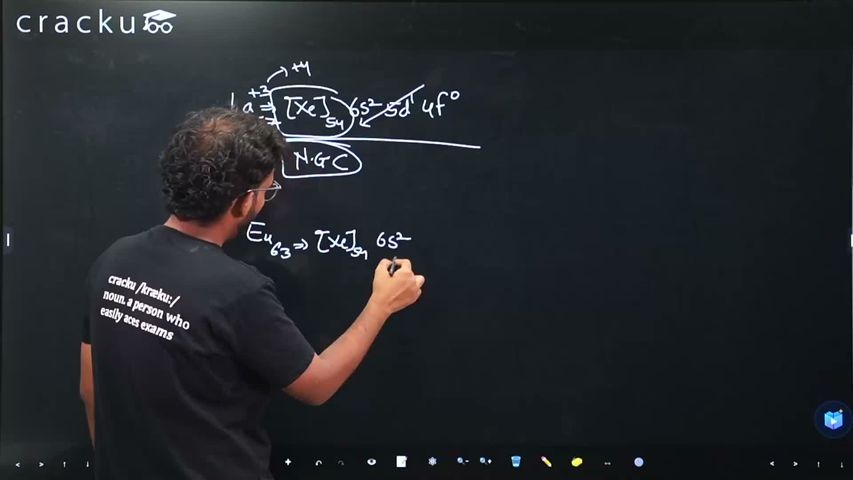
La (57): $$[Xe]\,5d^{1}\,6s^{2}$$
Ce (58): $$[Xe]\,4f^{1}\,5d^{1}\,6s^{2}$$
Eu (63): $$[Xe]\,4f^{7}\,6s^{2}$$
Gd (64): $$[Xe]\,4f^{7}\,5d^{1}\,6s^{2}$$
Step 2 : Examine the species obtained on forming the +4 state
La⁴⁺ : four electrons must be removed but La has only three valence electrons. The fourth electron would have to come from the inner $$[Xe]$$ core, giving a highly unstable configuration. Hence +4 is not feasible for La.
Ce⁴⁺ : removal of 4 electrons (two from 6s, one from 5d, one from 4f) gives exactly the noble-gas core $$[Xe]$$ (i.e. $$4f^{0}\,5d^{0}\,6s^{0}$$). A complete shell is exceptionally stable, so Ce readily forms the +4 oxidation state (e.g. $$CeO_2$$).
Eu⁴⁺ : after removing four electrons $$[Xe]\,4f^{7}\,6s^{2} \rightarrow [Xe]\,4f^{6}$$. The half-filled $$4f^{7}$$ subshell of Eu²⁺/Eu³⁺ is lost, giving lower stability; therefore Eu prefers +2 (half-filled 4f⁷) and +3 states, not +4.
Gd⁴⁺ : $$[Xe]\,4f^{7}\,5d^{1}\,6s^{2} \rightarrow [Xe]\,4f^{6}$$ after losing four electrons. Again the half-filled $$4f^{7}$$ is destroyed, so +4 is disfavoured. Gd is most stable in the +3 state (retaining 4f⁷).
Conclusion
Only cerium achieves a noble-gas configuration in the +4 state, making that oxidation state stable. None of the other given lanthanoids obtain a specially stable arrangement on losing four electrons.
Option C which is: $$Ce (Z = 58)$$
Was this solution helpful?
Click on the Email ☝️ to Watch the Video Solution
Create a FREE account and get:
_1.webp)

Educational materials for JEE preparation

Ask our AI anything

AI can make mistakes. Please verify important information.
AI can make mistakes. Please verify important information.


