
Join Our JEE Preparation Group
Prep with like-minded aspirants; Get access to free daily tests and study material.
Sign in
Please select an account to continue using cracku.in
↓ →
Join Our JEE Preparation Group
Prep with like-minded aspirants; Get access to free daily tests and study material.
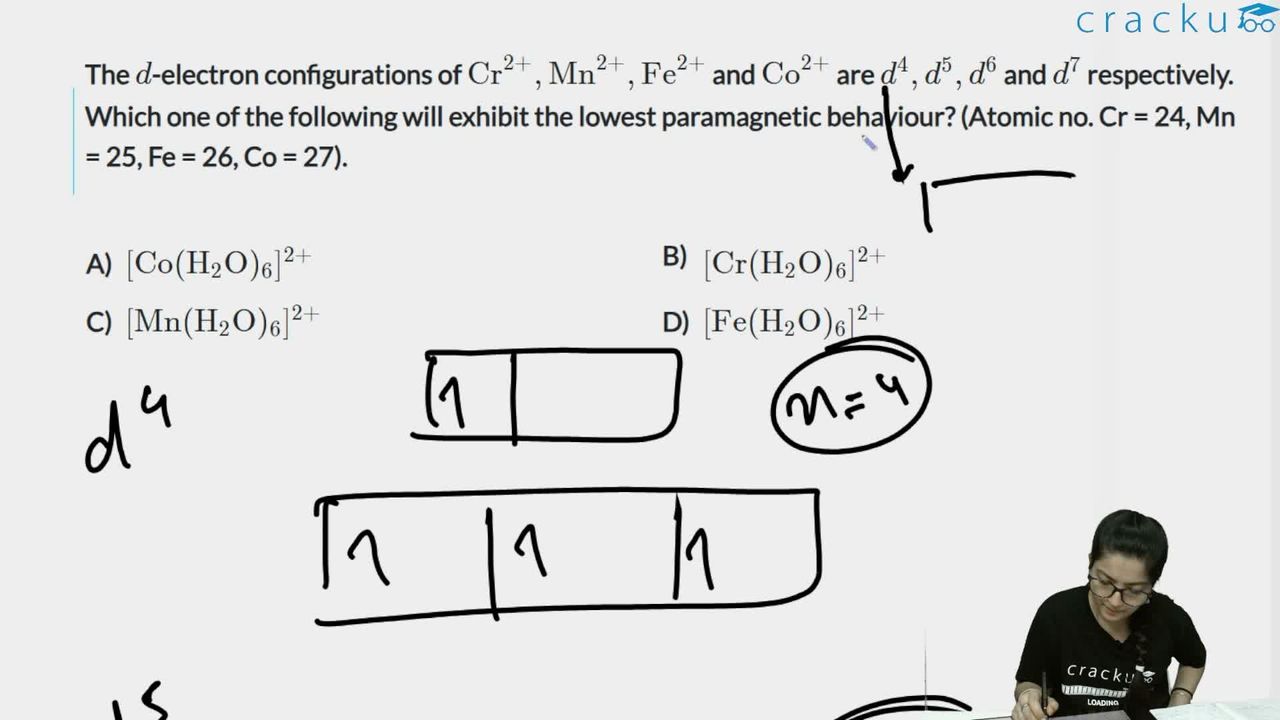
The $$d$$-electron configurations of $$\text{Cr}^{2+}, \text{Mn}^{2+}, \text{Fe}^{2+}$$ and $$\text{Co}^{2+}$$ are $$d^4, d^5, d^6$$ and $$d^7$$ respectively. Which one of the following will exhibit the lowest paramagnetic behaviour? (Atomic no. Cr = 24, Mn = 25, Fe = 26, Co = 27).
Magnetic behaviour of a coordination complex depends on the number of unpaired electrons, $$n$$.
Spin-only magnetic moment is given by $$\mu_\text{so}= \sqrt{n(n+2)}\;\text{BM}$$, so a smaller $$n$$ means weaker (lower) paramagnetism.
All four complexes contain the weak-field ligand $$\text{H}_2\text{O}$$.
In an octahedral field produced by a weak ligand, the crystal-field splitting energy ($$\Delta_\text{o}$$) is small; hence all the complexes are high-spin.
Therefore we distribute the metal-ion $$d$$ electrons according to Hund’s rule in the pattern $$t_{2g}^{\uparrow\uparrow\uparrow}e_g^{\uparrow\uparrow}t_{2g}^{\downarrow\downarrow\downarrow}\ldots$$ until all electrons are placed.
Case 1: $$[\text{Cr}(\text{H}_2\text{O})_6]^{2+}$$ : $$\text{Cr}^{2+}$$ is $$3d^4$$
High-spin arrangement: $$t_{2g}^{\uparrow\uparrow\uparrow}e_g^{\uparrow}$$ → $$n = 4$$ unpaired.
Case 2: $$[\text{Mn}(\text{H}_2\text{O})_6]^{2+}$$ : $$\text{Mn}^{2+}$$ is $$3d^5$$
High-spin arrangement: $$t_{2g}^{\uparrow\uparrow\uparrow}e_g^{\uparrow\uparrow}$$ → $$n = 5$$ unpaired.
Case 3: $$[\text{Fe}(\text{H}_2\text{O})_6]^{2+}$$ : $$\text{Fe}^{2+}$$ is $$3d^6$$
High-spin arrangement: $$t_{2g}^{\uparrow\uparrow\uparrow\downarrow}e_g^{\uparrow\uparrow}$$ → $$n = 4$$ unpaired.
Case 4: $$[\text{Co}(\text{H}_2\text{O})_6]^{2+}$$ : $$\text{Co}^{2+}$$ is $$3d^7$$
High-spin arrangement: $$t_{2g}^{\uparrow\uparrow\uparrow\downarrow\downarrow}e_g^{\uparrow\uparrow}$$ → $$n = 3$$ unpaired.
Comparison of unpaired electrons:
$$n_{[\text{Mn}]} = 5 \gt n_{[\text{Cr}]} = n_{[\text{Fe}]} = 4 \gt n_{[\text{Co}]} = 3$$
Since $$[\text{Co}(\text{H}_2\text{O})_6]^{2+}$$ has the smallest number of unpaired electrons, it exhibits the lowest paramagnetism.
Option A which is: $$[\text{Co}(\text{H}_2\text{O})_6]^{2+}$$
Was this solution helpful?
Click on the Email ☝️ to Watch the Video Solution
Create a FREE account and get:
_1.webp)

Educational materials for JEE preparation

Ask our AI anything

AI can make mistakes. Please verify important information.
AI can make mistakes. Please verify important information.


