Sign in
Please select an account to continue using cracku.in
↓ →
 CAT WhatsApp Group
Rahul starts on his journey at 5 pm at a constant speed so that he reaches his destination at 11 pm the same day. However, on his way, he stops for 20 minutes, and after that, increases his speed by 3 km per hour to reach on time. If he had stopped for 10 minutes more, he would have had to increase his speed by 5 km per hour to reach on time. His initial speed, in km per hour, was

Let the initial speed of Rahul be $$x$$ kilometres per hour. Since he travels the distance usually in $$6$$ hours, (5 pm to 11 pm), the total distance should be $$6\times x = 6x$$ kilometres.
Let the distance after which Rahul stops for some duration in both scenarios be $$y$$ kilometres.
In the first scenario, he stops for $$20$$ minutes or $$\dfrac{1}{3}$$ hours, therefore, the travel time would be $$6-\dfrac{1}{3} = \dfrac{17}{3}$$ hours. We have,
$$\dfrac{k}{x} + \dfrac{6x-k}{x+3} = \dfrac{17}{3}$$
$$\Rightarrow \dfrac{6x^2+3k}{x^2+3x} = \dfrac{17}{3}$$
$$\Rightarrow 18x^2 + 9k = 17x^2 + 51x$$
$$\Rightarrow x^2 = 51x - 9k$$ .....(1)
Similarly, in the second scenario, he stops for $$20+10=30$$ minutes or $$\dfrac{1}{2}$$ hours, therefore, the travel time would be $$6-\dfrac{1}{2} = \dfrac{11}{2}$$ hours. We have,
$$\dfrac{k}{x} + \dfrac{6x-k}{x+5} = \dfrac{11}{2}$$
$$\Rightarrow \dfrac{6x^2+5k}{x^2+5x} = \dfrac{11}{2}$$
$$\Rightarrow 12x^2 + 10k = 11x^2 + 55x$$
$$\Rightarrow x^2 = 55x - 10k$$ .....(2)
From equations (1) and (2), we have;
$$55x - 10k = 51x - 9k$$ or
$$4x = k$$.
Substituting the value of $$k$$ in equation (1), we have
$$x^2 = 51x - 36x$$ or, since $$x$$ is positive, $$x= 15$$. Therefore, option B is the correct answer.
Was this solution helpful?
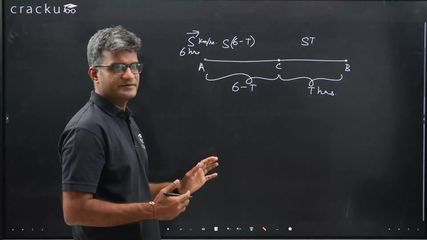
Click on the Email ☝️ to Watch the Video Solution
Create a FREE account and get:
Book Free CAT Mentorship
Get personalized CAT strategy from a 99%iler
500+ students mentored
OTP Verification
Enter the 6-digit code sent to your phone
Booking Summary
Enter OTP
Didn't receive the OTP?
Start your IIM journey with the right preparation and crack CAT 2026.

Educational materials for CAT preparation

Ask our AI anything

AI can make mistakes. Please verify important information.
AI can make mistakes. Please verify important information.
 91- 6303239042


