Join Our JEE Preparation Group
Prep with like-minded aspirants; Get access to free daily tests and study material.
Sign in
Please select an account to continue using cracku.in
↓ →
Join Our JEE Preparation Group
Prep with like-minded aspirants; Get access to free daily tests and study material.

Option A: $$\text{RCOOH}$$ (Carboxylic Acid)
This statement is incorrect. Nitriles can be hydrolyzed to carboxylic acids using strong aqueous acids or bases with prolonged heating, but a hydride reduction with DIBAL-H does not oxidize the carbon to an acid state.
Option B: $$\text{RCHO}$$ (Aldehyde)
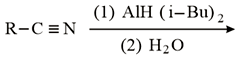
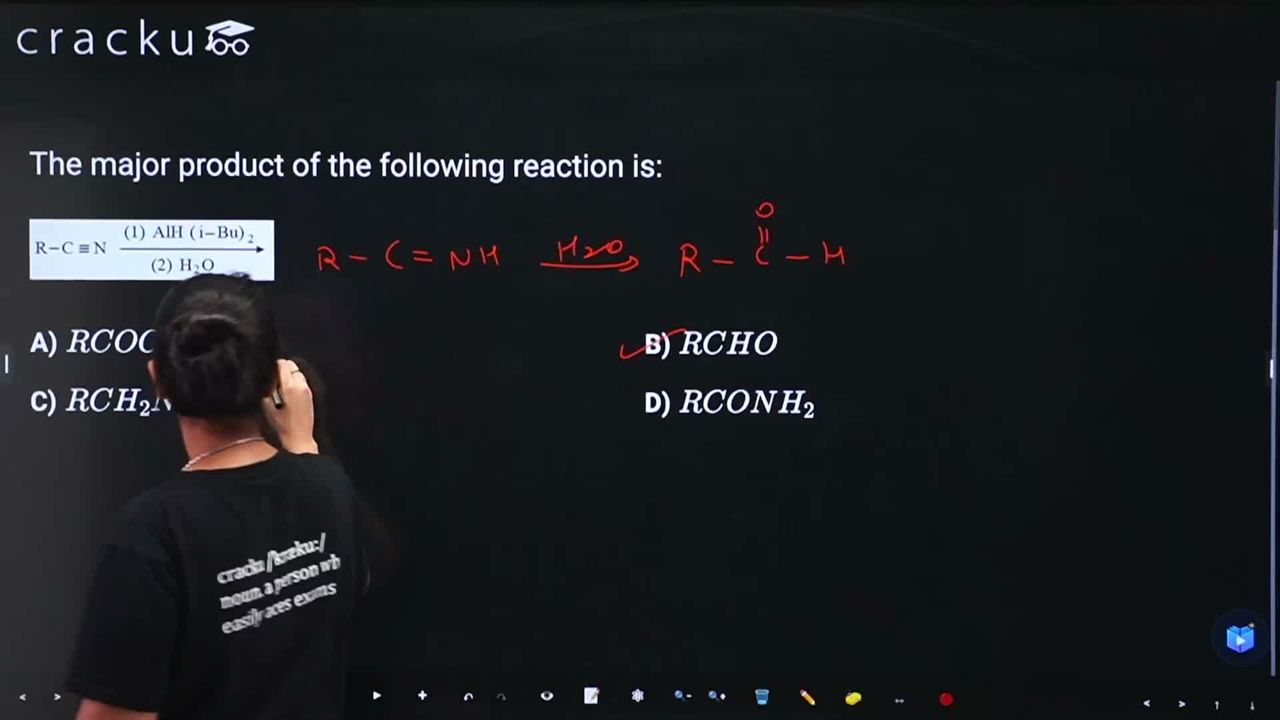
This statement is correct. The primary synthetic application of treating a nitrile with DIBAL-H followed by water is the controlled, selective conversion into an aldehyde.
Option C: $$\text{RCH}_2\text{NH}_2$$ (Primary Amine)
This statement is incorrect. Complete reduction down to a primary amine requires a much stronger, unhindered reducing agent like lithium aluminum hydride ($$\text{LiAlH}_4$$) or catalytic hydrogenation ($$\text{H}_2/\text{Pd}$$).
Option D: $$\text{RCONH}_2$$ (Primary Amide)
This statement is incorrect. An amide is formed during the partial chemical hydrolysis of a nitrile group, not through a hydride reduction pathway.
DIBAL-H reduces nitriles selectively to imines, which yield aldehydes upon subsequent aqueous workup.
Answer: Option B — $$\text{RCHO}$$
Was this solution helpful?
Click on the Email ☝️ to Watch the Video Solution
Create a FREE account and get:
_1.webp)

Educational materials for JEE preparation

Ask our AI anything

AI can make mistakes. Please verify important information.
AI can make mistakes. Please verify important information.