
Join Our JEE Preparation Group
Prep with like-minded aspirants; Get access to free daily tests and study material.
Sign in
Please select an account to continue using cracku.in
↓ →
Join Our JEE Preparation Group
Prep with like-minded aspirants; Get access to free daily tests and study material.
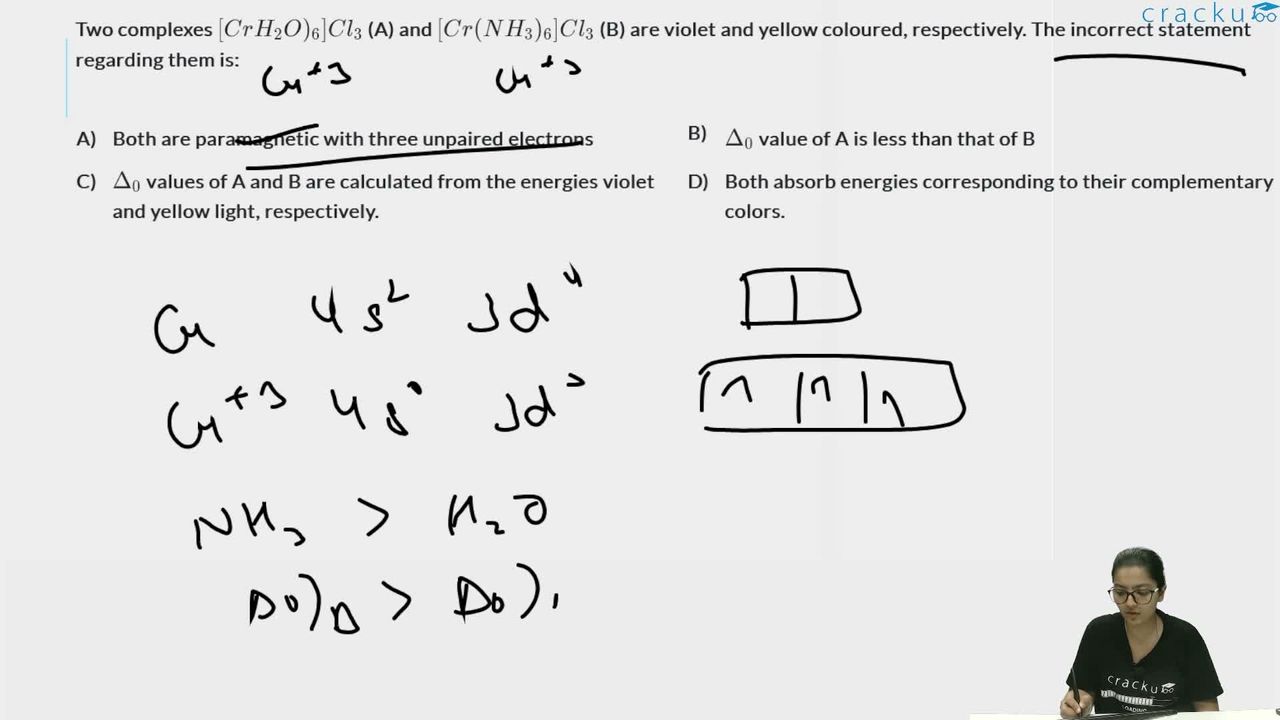
Two complexes $$[CrH_2O)_6]Cl_3$$ (A) and $$[Cr(NH_3)_6]Cl_3$$ (B) are violet and yellow coloured, respectively. The incorrect statement regarding them is:
First we note that both complexes A and B contain the metal ion $$\text{Cr}^{3+}$$ because each chloride in the lattice contributes one negative charge outside the coordination sphere:
$$[\,\text{CrL}_6]^{3+} + 3\text{Cl}^- \longrightarrow \text{overall neutral complex salt}$$
The electronic configuration of the free ion $$\text{Cr}^{3+}$$ is obtained from that of chromium, $$[\,\text{Ar}]\,3d^5 4s^1$$, by removing three electrons:
$$[\,\text{Ar}]\,3d^3$$
In an octahedral crystal field the five d-orbitals split into a lower energy set $$t_{2g}$$ and a higher energy set $$e_g$$. For a $$d^3$$ ion we fill the lower set singly according to Hund’s rule:
$$t_{2g}^3\,e_g^0$$
Thus we have
• number of unpaired electrons $$n = 3$$
The spin-only magnetic moment formula is stated first:
$$\mu_\text{spin} = \sqrt{n(n+2)}\;\text{BM}$$
Substituting $$n = 3$$ gives
$$\mu_\text{spin} = \sqrt{3(3+2)} = \sqrt{15}\;\text{BM} \approx 3.87\;\text{BM}$$
This value corresponds to paramagnetism with three unpaired electrons for both A and B. So the statement “Both are paramagnetic with three unpaired electrons” is true.
Next we compare crystal-field splitting energies $$\Delta_0$$ by using the spectrochemical series, which we state:
$$\text{CN}^- > \text{NH}_3 > \text{H}_2O > \text{F}^- \dots$$
Because $$\text{NH}_3$$ is to the left of $$\text{H}_2O$$, it is the stronger field ligand, so
$$\Delta_0(\text{NH}_3) > \Delta_0(\text{H}_2O)$$
Hence
$$\Delta_0(B) > \Delta_0(A)$$
or equivalently
$$\Delta_0(A) < \Delta_0(B)$$
Therefore the statement “$$\Delta_0$$ value of A is less than that of B” is also true.
Now we examine the colours. A looks violet while B looks yellow. An observed colour is the light transmitted/reflected; the complex actually absorbs the complementary colour. The complementary pairs important here are stated:
• Violet ↔ Yellow-green
• Yellow ↔ Blue-violet
Hence:
• Complex A (violet) absorbs yellow-green light.
• Complex B (yellow) absorbs blue-violet light.
Therefore the splitting energy $$\Delta_0$$ for A is calculated from the frequency (energy) of yellow-green light, and that for B from the frequency of blue-violet light, not from violet and yellow themselves. So the statement “$$\Delta_0$$ values of A and B are calculated from the energies of violet and yellow light, respectively” is false.
Finally, the assertion “Both absorb energies corresponding to their complementary colours” is exactly what we have used above, making it a correct statement.
Summarising the truth values:
A - true, B - true, C - false, D - true.
Hence, the correct answer is Option C.
Was this solution helpful?
Click on the Email ☝️ to Watch the Video Solution
Create a FREE account and get:
_1.webp)

Educational materials for JEE preparation

Ask our AI anything

AI can make mistakes. Please verify important information.
AI can make mistakes. Please verify important information.
