
Join Our JEE Preparation Group
Prep with like-minded aspirants; Get access to free daily tests and study material.
Sign in
Please select an account to continue using cracku.in
↓ →
Join Our JEE Preparation Group
Prep with like-minded aspirants; Get access to free daily tests and study material.
Zinc blende is $$ZnS$$ (sphalerite). The commercial extraction of zinc from $$ZnS$$ proceeds in three main stages.
Step 1 : Concentration of ore
The mined ore first undergoes froth‐flotation to remove silica and other earthy impurities. This physical step only upgrades the ore and does not alter its chemical nature, so it does not decide the answer we seek.
Step 2 : Roasting
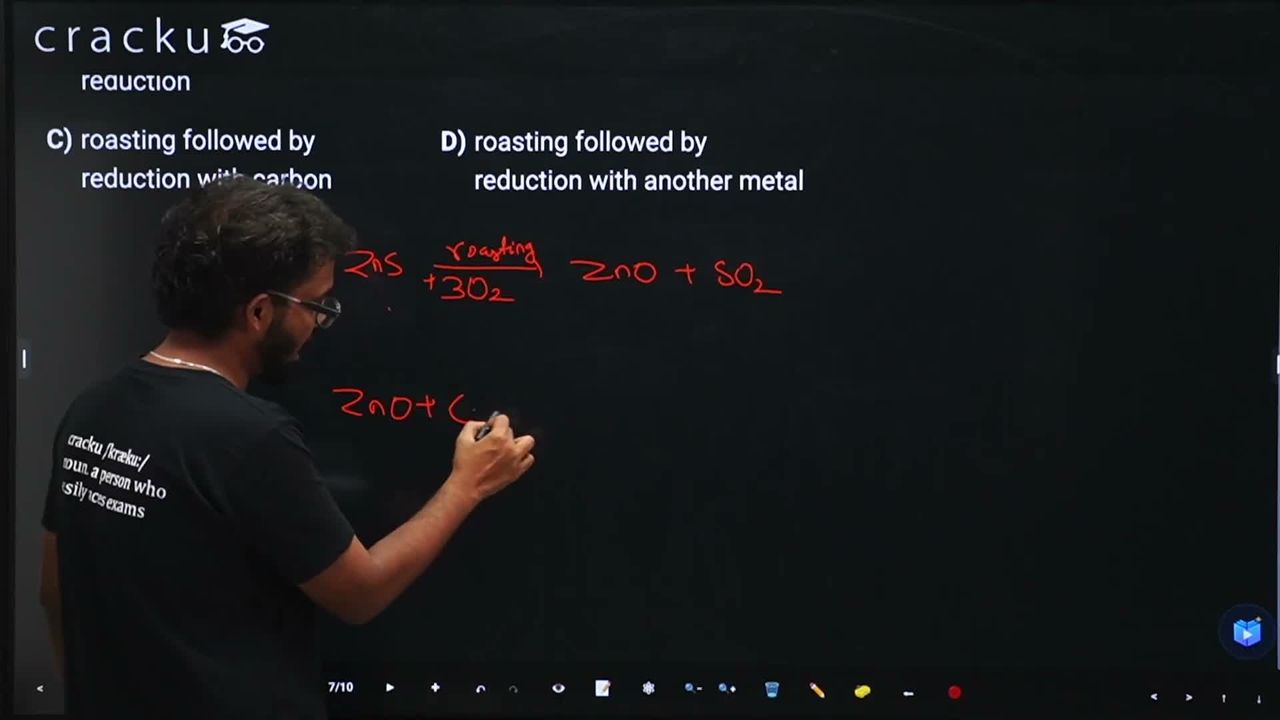
The concentrated $$ZnS$$ is roasted in excess air at about $$900\;^\circ\text{C}$$:
$$2\,ZnS + 3\,O_2 \;\xrightarrow{\text{roast}}\; 2\,ZnO + 2\,SO_2$$
Roasting converts the sulphide into zinc oxide, which is easier to reduce.
Step 3 : Reduction of zinc oxide
The oxide is then heated with coke (carbon) in a vertical shaft furnace around $$1200\;^\circ\text{C}$$:
$$ZnO + C \;\xrightarrow{1200^\circ\text{C}}\; Zn(\text{vapour}) + CO$$
Zinc vapor is distilled off and condensed. Thus the chemical reduction agent is carbon (usually in the form of coke).
Why the other options are incorrect
• Option A - Self-reduction is applicable to ores like $$Cu_2S$$, $$PbS$$, $$HgS$$ where the metal sulphide and oxide roast together. $$ZnS$$ does not undergo such auto-reduction.
• Option B - Electrolytic reduction is used for highly active metals such as $$Na$$, $$K$$, $$Al$$, not for zinc obtained from a sulphide ore.
• Option D - Reduction with another metal (e.g., Al in the thermite process) is unnecessary and uneconomical for zinc.
Therefore the industrial route is: roasting of $$ZnS$$ to $$ZnO$$ followed by reduction with carbon.
Option C which is: roasting followed by reduction with carbon
Was this solution helpful?
Click on the Email ☝️ to Watch the Video Solution
Create a FREE account and get:
_1.webp)

Educational materials for JEE preparation

Ask our AI anything

AI can make mistakes. Please verify important information.
AI can make mistakes. Please verify important information.
