
Join Our JEE Preparation Group
Prep with like-minded aspirants; Get access to free daily tests and study material.
Sign in
Please select an account to continue using cracku.in
↓ →
Join Our JEE Preparation Group
Prep with like-minded aspirants; Get access to free daily tests and study material.
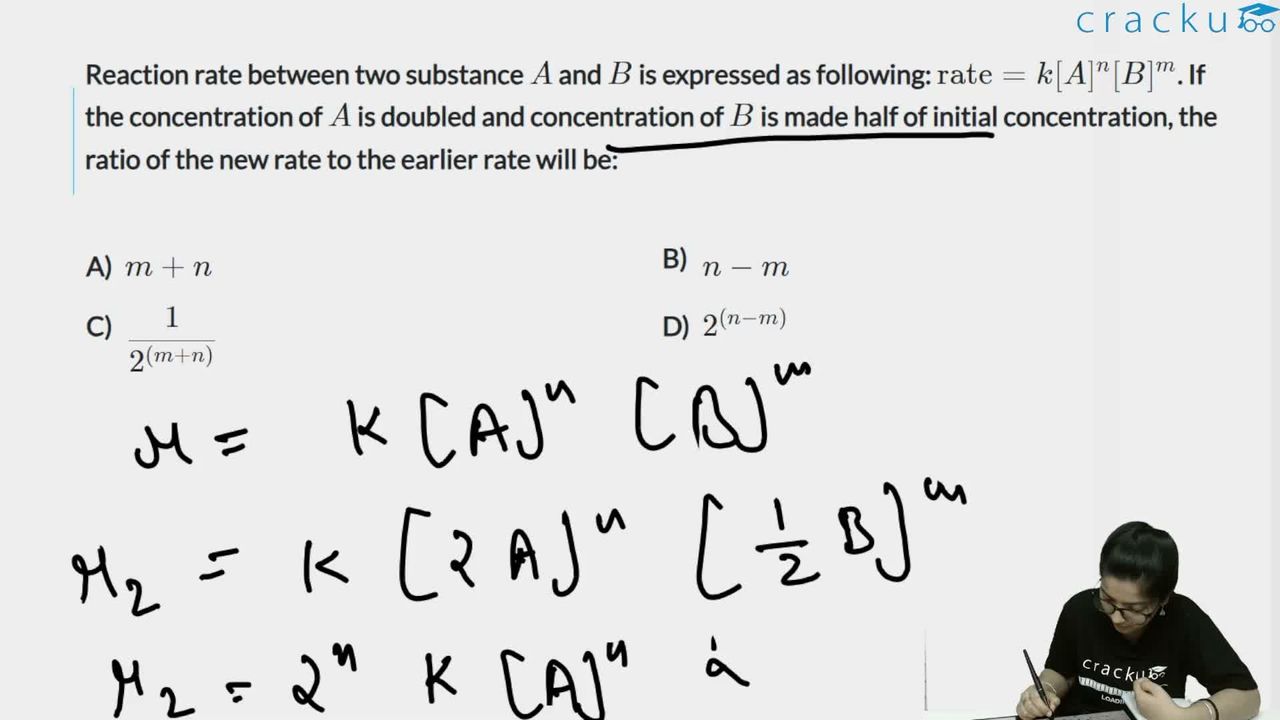
Reaction rate between two substance $$A$$ and $$B$$ is expressed as following: $$\text{rate} = k[A]^n[B]^m$$. If the concentration of $$A$$ is doubled and concentration of $$B$$ is made half of initial concentration, the ratio of the new rate to the earlier rate will be:
The given rate law is
$$\text{rate}_1 = k[A]^n[B]^m$$
Apply the stated changes in concentrations:
• $$[A]$$ is doubled → $$[A]' = 2[A]$$
• $$[B]$$ is halved → $$[B]' = \tfrac12[B]$$
The new rate becomes
$$\text{rate}_2 = k([A]')^n([B]')^m
= k\,(2[A])^n\!\left(\tfrac12[B]\right)^{\!m}$$
Simplify the powers of 2:
$$\text{rate}_2
= k\,2^{\,n}[A]^n \cdot 2^{-\,m}[B]^m
= 2^{\,n-m}\,k[A]^n[B]^m
= 2^{\,n-m}\,\text{rate}_1$$
Hence the ratio of the new rate to the original rate is
$$\frac{\text{rate}_2}{\text{rate}_1} = 2^{\,n-m}$$
Therefore, the correct choice is:
Option D which is: $$2^{(n-m)}$$
Was this solution helpful?
Click on the Email ☝️ to Watch the Video Solution
Create a FREE account and get:
_1.webp)

Educational materials for JEE preparation

Ask our AI anything

AI can make mistakes. Please verify important information.
AI can make mistakes. Please verify important information.


