
Join Our JEE Preparation Group
Prep with like-minded aspirants; Get access to free daily tests and study material.
Sign in
Please select an account to continue using cracku.in
↓ →
Join Our JEE Preparation Group
Prep with like-minded aspirants; Get access to free daily tests and study material.
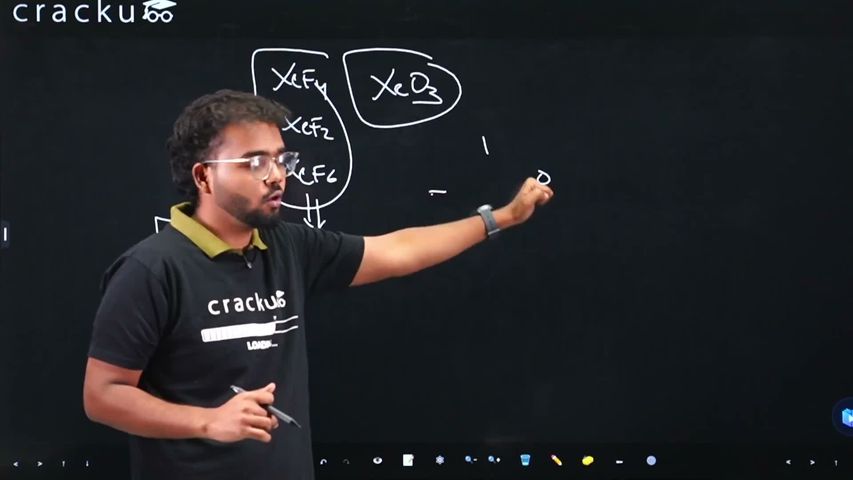
First, recall the stable oxidation states and the usual inter-conversions of xenon compounds.
• In $$XeF_2, XeF_4,$$ and $$XeF_6$$ the oxidation state of xenon is $$+2,+4$$ and $$+6$$ respectively.
• In $$XeO_3$$ xenon is also in the $$+6$$ state, but the Xe-O bond is much stronger and far less labile than the Xe-F bond because oxygen is doubly bonded to xenon through $$p\pi-d\pi$$ back bonding.
• Replacing -O- by -F- therefore needs a very strong fluorinating agent such as $$F_2$$, $$ClF_3$$ or $$BrF_5$$; anhydrous $$HF$$ is far too weak.
Now analyse each option.
Option A
$$XeO_3 + 6HF \rightarrow XeF_6 + 3H_2O$$
Both xenon compounds are in the same oxidation state $$+6$$, so the reaction, if it occurred, would merely exchange O ligands for F ligands. HF is only a weak fluorinating agent (it is in fact routinely produced as a by-product when XeFn are hydrolysed). It cannot break the strong Xe-O bonds present in $$XeO_3$$, hence this conversion is not feasible under ordinary conditions.
Option B
$$3XeF_4 + 6H_2O \rightarrow 2Xe + XeO_3 + 12HF + 1.5O_2$$
Hydrolysis of $$XeF_4$$ is well documented. Fluoride ions are protonated to give $$HF$$, xenon is partly reduced to the elemental state and partly oxidised to $$XeO_3$$, and dioxygen is released. Therefore this reaction is feasible.
Option C
$$2XeF_2 + 2H_2O \rightarrow 2Xe + 4HF + O_2$$
$$XeF_2$$ undergoes auto-redox (disproportionation) in water exactly as written, giving back xenon gas, $$HF$$ and $$O_2$$. The reaction is experimentally observed, so it is feasible.
Option D
$$XeF_6 + RbF \rightarrow Rb[XeF_7]$$
Addition of a fluoride ion to $$XeF_6$$ produces the heptafluoroxenate(VI) anion $$[XeF_7]^-$$. Alkali-metal salts such as $$Cs[XeF_7]$$ and $$Rb[XeF_7]$$ are isolable solids; hence this reaction is also feasible.
Only Option A involves replacing strong Xe-O bonds by Xe-F bonds using weak HF, which is not possible. All the other reactions are standard hydrolysis or fluoride-addition processes that do occur.
Therefore the reaction that is not feasible is:
Option A which is: $$XeO_3 + 6HF \to XeF_6 + 3H_2O$$
Was this solution helpful?
Click on the Email ☝️ to Watch the Video Solution
Create a FREE account and get:
_1.webp)

Educational materials for JEE preparation

Ask our AI anything

AI can make mistakes. Please verify important information.
AI can make mistakes. Please verify important information.
