
Join Our JEE Preparation Group
Prep with like-minded aspirants; Get access to free daily tests and study material.
Sign in
Please select an account to continue using cracku.in
↓ →
Join Our JEE Preparation Group
Prep with like-minded aspirants; Get access to free daily tests and study material.
The plot shows the variation of $$-\ln K_P$$ versus temperature for the two reactions.
$$M(s) + \frac{1}{2}O_2(g) \to MO(s)$$ and
$$C(s) + \frac{1}{2}O_2(g) \to CO(s)$$
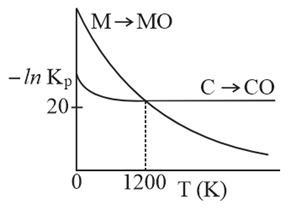
Identify the correct statement:
The standard Gibbs free energy change for a reaction is related to the equilibrium constant by the equation: $$\Delta G^\circ = -RT \ln K_p$$
$$-\ln K_p = \frac{\Delta G^\circ}{RT}$$
In a plot of $$\frac{\Delta G^\circ}{RT}$$ versus temperature, the lower a line is, the more negative the $$\Delta G^\circ$$ value is relative to the other reaction. This indicates that the oxide formed in that reaction is more stable at that specific temperature.
For a reduction reaction like $$MO(s) + C(s) \rightarrow M(s) + CO(g)$$, the net change in Gibbs free energy ($$\Delta G^\circ_{net}$$) is: $$\Delta G^\circ_{net} = \Delta G^\circ(\text{Oxidation of Carbon}) - \Delta G^\circ(\text{Oxidation of Metal})$$
The reaction is spontaneous if $$\Delta G^\circ_{net} < 0$$. This occurs when $$\Delta G^\circ(\text{Oxidation of Carbon}) < \Delta G^\circ(\text{Oxidation of Metal})$$
Graphically, this means the line for the oxidation of carbon ($$C \rightarrow CO$$) must be below the line for the oxidation of the metal ($$M \rightarrow MO$$).
At $$T < 1200\ \text{K}$$: The curve for $$C \rightarrow CO$$ lies below the curve for $$M \rightarrow MO$$. This means $$\frac{\Delta G^\circ(C \to CO)}{RT} < \frac{\Delta G^\circ(M \to MO)}{RT}$$, which implies $$\Delta G^\circ_{net} < 0$$. Therefore, carbon can reduce the metal oxide ($$MO$$), making the reaction spontaneous.
At $$T > 1200\ \text{K}$$: The curve for $$M \rightarrow MO$$ lies below the curve for $$C \rightarrow CO$$. In this region, the metal $$M$$ is a better reducing agent than carbon, so carbon cannot reduce $$MO$$.
Was this solution helpful?
Create a FREE account and get:
_1.webp)

Educational materials for JEE preparation

Ask our AI anything

AI can make mistakes. Please verify important information.
AI can make mistakes. Please verify important information.
