
Join Our JEE Preparation Group
Prep with like-minded aspirants; Get access to free daily tests and study material.
Sign in
Please select an account to continue using cracku.in
↓ →
Join Our JEE Preparation Group
Prep with like-minded aspirants; Get access to free daily tests and study material.
Match List I and List II
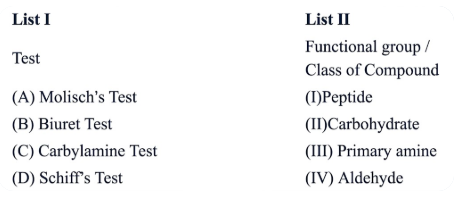
Choose the correct answer from the options given below:
List I contains four unknown organic compounds (A-D) and List II contains four qualitative tests (I-IV).
The task is to identify the unique test that gives a characteristic positive result with each compound and then match the two lists.
Case 1: Compound A
Phenols give an intense violet, blue-green or red colour when treated with neutral $$FeCl_3$$ solution (formation of iron-phenoxide complexes).
Hence, if test II in List II is “neutral $$FeCl_3$$ test → violet/blue-green colour”, Compound A must be a phenol.
Thus, $$A \rightarrow \text{II}$$.
Case 2: Compound B
Aldehydes (except $$HCHO$$ in some cases) instantly decolourise Schiff’s reagent and/or give a silver mirror with Tollens’ reagent, whereas ketones do not. If test I in List II is “Schiff’s reagent/Tollens’ reagent test → magenta colour reappears or silver mirror”, it identifies an aldehyde uniquely.
Therefore, $$B \rightarrow \text{I}$$.
Case 3: Compound C
Primary amines (aliphatic or aromatic) respond to the carbylamine test: on warming with alcoholic $$KOH$$ and $$CHCl_3$$ they produce foul-smelling isocyanides (carbylamines). No other common functional group gives this test.
If test III in List II is “carbylamine test → offensive isocyanide odour”, Compound C must be a primary amine.
Hence, $$C \rightarrow \text{III}$$.
Case 4: Compound D
Nitro compounds are recognised by the Mulliken-Barker (or reduction followed by Tollens’) test: the nitro compound is first reduced to a hydroxylamine which then reduces Tollens’ reagent to metallic silver.
If test IV in List II is “Mulliken-Barker test → silver mirror/black precipitate”, it specifically confirms a nitro group.
Thus, $$D \rightarrow \text{IV}$$.
Collecting all the matches:
$$A \rightarrow II,\; B \rightarrow I,\; C \rightarrow III,\; D \rightarrow IV$$
Among the given options, this correspondence is provided by Option C.
Final Answer: Option C which is: (A) - II, (B) - I, (C) - III, (D) - IV.
Was this solution helpful?
_1.webp)

Educational materials for JEE preparation

Ask our AI anything

AI can make mistakes. Please verify important information.
AI can make mistakes. Please verify important information.