
Join Our JEE Preparation Group
Prep with like-minded aspirants; Get access to free daily tests and study material.
Sign in
Please select an account to continue using cracku.in
↓ →
Join Our JEE Preparation Group
Prep with like-minded aspirants; Get access to free daily tests and study material.
Colloidal solutions always contain small amounts of impurities such as dissolved ions or excess electrolytes that remain in the dispersion medium. These impurities must be removed when a pure sol is required.
The technique traditionally used for this purpose is dialysis. In dialysis the sol is placed inside a parchment or cellophane bag, and the bag is immersed in running water. Small ions and molecules diffuse out through the semipermeable membrane, while the larger colloidal particles are retained inside. However, ordinary dialysis is slow because the driving force is only the concentration gradient.
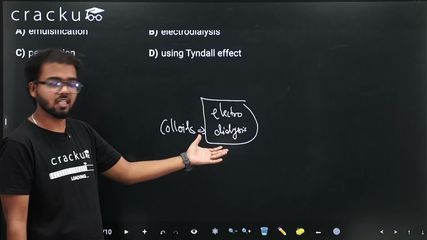
To speed up the process an electric field can be applied across the dialysis membrane. The ions present in the colloid migrate faster toward the oppositely charged electrodes, while the colloidal particles (being much larger) are still unable to pass through the membrane. This accelerated form of dialysis is called electrodialysis. It is the most efficient laboratory method for purifying colloidal solutions.
The other options are not purification techniques:
• Emulsification is the dispersion of one liquid in another immiscible liquid.
• Peptization converts a precipitate into a colloidal sol by adding a suitable electrolyte.
• The Tyndall effect is only an optical test used to detect the presence of colloidal particles; it does not remove impurities.
Therefore, the correct method for purifying colloidal solutions is electrodialysis.
Option B which is: electrodialysis
Was this solution helpful?
Click on the Email ☝️ to Watch the Video Solution
Create a FREE account and get:
_1.webp)

Educational materials for JEE preparation

Ask our AI anything

AI can make mistakes. Please verify important information.
AI can make mistakes. Please verify important information.


