Join Our JEE Preparation Group
Prep with like-minded aspirants; Get access to free daily tests and study material.
Sign in
Please select an account to continue using cracku.in
↓ →
Join Our JEE Preparation Group
Prep with like-minded aspirants; Get access to free daily tests and study material.
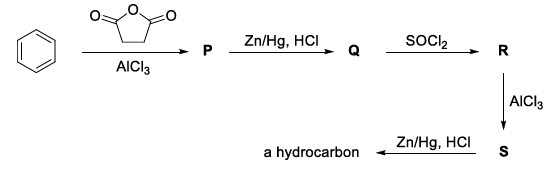
The reaction sequence (reagents are given in the paper) converts the starting hydrocarbon first into an aldehyde and finally into two oxidised products P and Q. Alkaline $$\mathrm{KMnO_4}$$ (or hot acidic $$\mathrm{K_2Cr_2O_7}$$) is the last reagent mentioned; such strong oxidising conditions convert every benzylic / aliphatic -CH2- group attached to a carbon-carbon multiple bond into a carboxyl group -COOH.
Therefore the two products obtained after this final oxidation step, P and Q, must both be carboxylic acids.
Hence, statement A
Option A : “Compounds P and Q are carboxylic acids.”
is correct.
Let us examine the other three statements one by one.
Statement B
“Compound S decolorises bromine water.”
Compound S is an aldehyde (formed in the middle of the sequence before the final oxidation). Ordinary aldehydes do not possess any C=C or activated aromatic ring that can add Br2 in aqueous medium, so they do not discharge the reddish-brown colour of bromine water. Hence statement B is incorrect.
Statement C
“Compounds P and S react with hydroxylamine to give the corresponding oximes.”
Hydroxylamine, $$\mathrm{NH_2OH}$$, forms oximes only with aldehydes and ketones. It does not react with carboxylic acids under ordinary conditions. Since P is a carboxylic acid, it will not give an oxime. Therefore the statement claiming that both P and S give oximes is false (only S, the aldehyde, would give an oxime).
Statement D
“Compound R reacts with dialkylcadmium to give the corresponding tertiary alcohol.”
Compound R in the sequence is an acyl chloride, $$\mathrm{RCOCl}$$. Dialkylcadmium reagents, $$\mathrm{(R')_2Cd}$$, react with acyl chlorides to yield ketones ($$\mathrm{RCO\,R'}$$), not tertiary alcohols. Therefore statement D is also incorrect.
Only statement A is correct.
Final Answer: Option A which is: Compounds P and Q are carboxylic acids.
Was this solution helpful?
Create a FREE account and get:
_1.webp)

Educational materials for JEE preparation

Ask our AI anything

AI can make mistakes. Please verify important information.
AI can make mistakes. Please verify important information.