
Join Our JEE Preparation Group
Prep with like-minded aspirants; Get access to free daily tests and study material.
Sign in
Please select an account to continue using cracku.in
↓ →
Join Our JEE Preparation Group
Prep with like-minded aspirants; Get access to free daily tests and study material.
A battery is constructed of Cr and $$\text{Na}_2\text{Cr}_2\text{O}_7$$. The unbalanced chemical equation when such a battery discharges is following: $$$\text{Na}_2\text{Cr}_2\text{O}_7 + \text{Cr} + \text{H}^+ \rightarrow \text{Cr}^{3+} + \text{H}_2\text{O} + \text{Na}^+$$$ If one Faraday of electricity is passed through the battery during the charging, the number of moles of $$\text{Cr}^{3+}$$ removed from the solution is
The problem provides an unbalanced equation for the discharge of the battery. During charging, the exact reverse reaction takes place. The $$\text{Cr}^{3+}$$ ions present in the solution will be consumed (removed) as they undergo an oxidation or reduction process back to their initial states.
Let's find the change in oxidation states for the chromium species during discharge to understand how they behave:
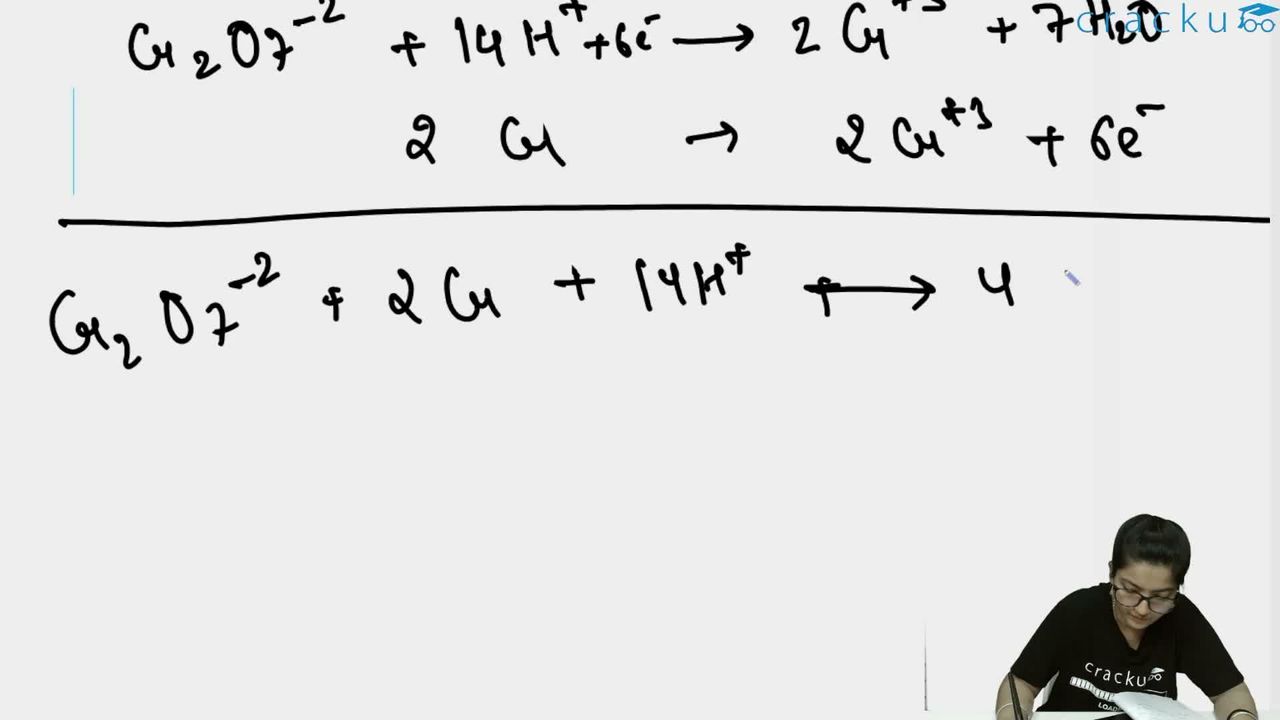
Therefore, the total process involves two distinct chromium half-reactions during discharge:
To obtain the overall balanced cell reaction for discharging, we multiply the oxidation half-reaction by 2 so that the number of transferred electrons ($$6e^-$$) matches:
Adding these together gives the total balanced discharge reaction:
$$\text{Na}_2\text{Cr}_2\text{O}_7 + 2\text{Cr} + 14\text{H}^+ \rightarrow 4\text{Cr}^{3+} + 7\text{H}_2\text{O} + 2\text{Na}^+$$
From our balanced configuration, we can establish the relationship between the moles of $$\text{Cr}^{3+}$$ and the quantity of electricity (electrons) passed:
Using a simple unitary method for $$1\text{ Faraday}$$ of electricity passed during charging:
$$\text{Moles of }\text{Cr}^{3+}\text{ removed} = \frac{4\text{ moles of }\text{Cr}^{3+}}{6\text{ F}} \times 1\text{ F} = \frac{2}{3}\text{ mole}$$
Passing one Faraday of electricity through the system will result in the consumption of exactly $$\frac{2}{3}$$ mole of $$\text{Cr}^{3+}$$ from the solution environment.
Answer: Option D — $$\frac{2}{3}$$
Was this solution helpful?
Click on the Email ☝️ to Watch the Video Solution
Create a FREE account and get:
_1.webp)

Educational materials for JEE preparation

Ask our AI anything

AI can make mistakes. Please verify important information.
AI can make mistakes. Please verify important information.


