
Join Our JEE Preparation Group
Prep with like-minded aspirants; Get access to free daily tests and study material.
Sign in
Please select an account to continue using cracku.in
↓ →
Join Our JEE Preparation Group
Prep with like-minded aspirants; Get access to free daily tests and study material.
Match List I with List II
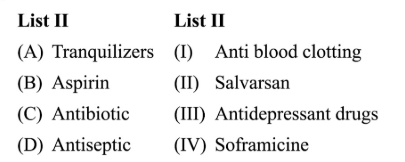
Choose the correct answer from the options given below:
List I contains four common substitution/elimination mechanisms, while List II describes their characteristic features.
Case A ($$S_N1$$)
• $$S_N1$$ stands for unimolecular nucleophilic substitution.
• The rate-determining step is ionisation of the substrate to give a carbocation; only the substrate appears in the rate law.
Therefore it involves a carbocation intermediate → matches List II (III).
Case B ($$S_N2$$)
• $$S_N2$$ is bimolecular nucleophilic substitution.
• The nucleophile attacks from the backside in the same step in which the leaving group departs; both species appear in the rate law.
Thus it is bimolecular and follows second-order kinetics → matches List II (I).
Case C ($$E1$$)
• $$E1$$ is unimolecular elimination.
• The slow step is again ionisation to give a carbocation; only the substrate concentration controls the rate.
Hence it is unimolecular and first-order → matches List II (II).
Case D ($$E2$$)
• $$E2$$ is bimolecular elimination that occurs in one concerted step.
• The proton and the leaving group depart simultaneously; maximum overlap requires an anti-periplanar arrangement in the transition state.
So it is a single-step, concerted elimination with an anti-periplanar transition state → matches List II (IV).
Collecting the correct pairings:
(A) → III, (B) → I, (C) → II, (D) → IV
Among the options, this combination corresponds to Option C: (A)-III, (B)-I, (C)-II, (D)-IV.
Was this solution helpful?
_1.webp)

Educational materials for JEE preparation

Ask our AI anything

AI can make mistakes. Please verify important information.
AI can make mistakes. Please verify important information.