Join Our JEE Preparation Group
Prep with like-minded aspirants; Get access to free daily tests and study material.
Sign in
Please select an account to continue using cracku.in
↓ →
Join Our JEE Preparation Group
Prep with like-minded aspirants; Get access to free daily tests and study material.
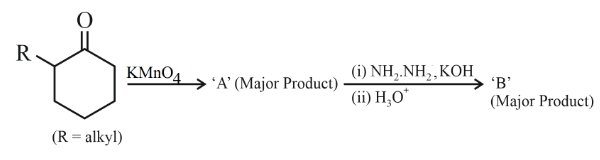
The starting material is a 2-alkylcyclohexanone (a cyclic ketone with an alkyl group $$R$$ at the $$\alpha$$-position).
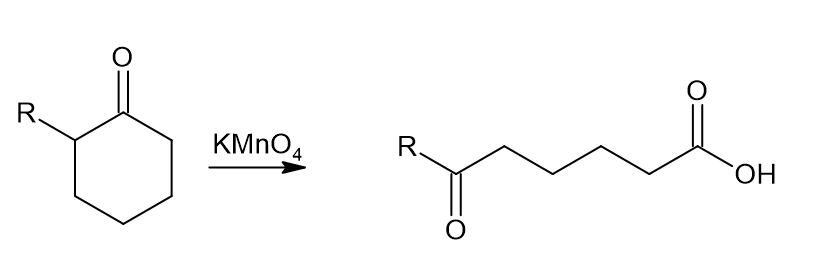
When treated with a strong oxidizing agent like $$\text{KMnO}_4$$, cyclic ketones undergo oxidative cleavage of the $$\text{C}-\text{C}$$ bond adjacent to the carbonyl group.
Regioselectivity: The bond cleavage preferentially occurs between the carbonyl carbon ($$\text{C}_1$$) and the more substituted $$\alpha$$-carbon ($$\text{C}_2$$, which bears the alkyl group $$R$$).
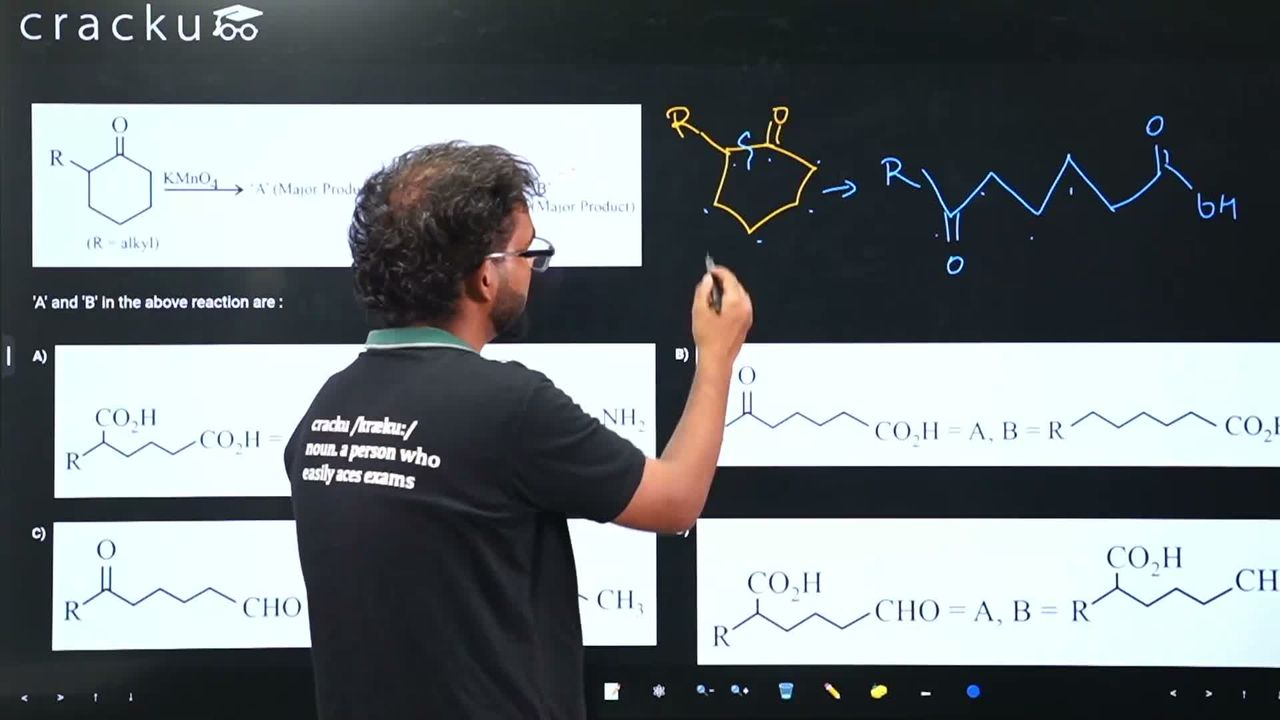
The carbonyl carbon ($$\text{C}_1$$) is oxidized to a carboxylic acid ($$-\text{CO}_2\text{H}$$), and the substituted $$\alpha$$-carbon ($$\text{C}_2$$) is oxidized to a ketone ($$-\text{C}(=\text{O})R$$) group because it holds the alkyl chain.
Thus, the ring opens up to form a keto-acid.
Product 'A' is then treated with hydrazine and a strong base ($$\text{NH}_2\text{NH}_2, \text{KOH}$$) followed by acidic workup ($$\text{H}_3\text{O}^+$$). This reagent combination describes a Wolff-Kishner Reduction.
The Wolff-Kishner reduction selectively converts carbonyl groups ($$\text{C}=\text{O}$$) of aldehydes and ketones into methylene groups ($$\text{CH}_2$$).
Selectivity: It does not reduce carboxylic acid ($$-\text{CO}_2\text{H}$$) groups.
The ketone carbonyl group ($$\text{C}=\text{O}$$) attached to $$R$$ is completely reduced to a $$-\text{CH}_2-$$ group.

Correct Option B.
Was this solution helpful?
Click on the Email ☝️ to Watch the Video Solution
Create a FREE account and get:
_1.webp)

Educational materials for JEE preparation

Ask our AI anything

AI can make mistakes. Please verify important information.
AI can make mistakes. Please verify important information.