Join WhatsApp Icon JEE WhatsApp Group
Question 47

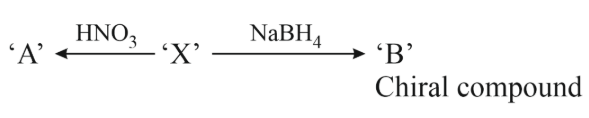
L-isomer of tetrose X (C$$_4$$H$$_8$$O$$_4$$) gives positive Schiff's test and has two chiral carbons. On acetylation 'X' yields triacetate. 'X' also undergoes following reactions
image

  • Positive Schiff's test: Indicates the presence of a free aldehyde group ($$\text{-CHO}$$).
  • Acetylation yielding a triacetate: Out of the 4 oxygen atoms in tetrose $$\text{C}_4\text{H}_8\text{O}_4$$, one belongs to the aldehyde group (which does not undergo acetylation). The remaining 3 oxygen atoms form 3 hydroxyl groups ($$\text{-OH}$$), which are acetylated.
  • Therefore, X is an aldotetrose (a 4-carbon sugar containing one $$\text{-CHO}$$ and three $$\text{-OH}$$ groups) with two chiral centers.
  • There are two open-chain aldotetroses: Erythrose and Threose.

    • When reduced with $$\text{NaBH}_4$$, the $$\text{-CHO}$$ group is converted into a primary alcohol ($$\text{-CH}_2\text{OH}$$):
      • Erythrose reduces to erythritol, which has a plane of symmetry and is an optically inactive meso (achiral) compound.
      • Threose reduces to threitol, which has no plane of symmetry and remains an optically active chiral compound.

    Since the reaction of 'X' with $$\text{NaBH}_4$$ yields a Chiral compound ('B'), X must be Threose.

    for the L-isomer of X.
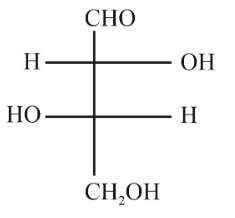
    • In carbohydrate chemistry (Fischer projections), "L" means the $$\text{-OH}$$ group on the bottom-most chiral carbon (Carbon-3 in this case) points to the Left.
    • Since it's a Threose, the two middle $$\text{-OH}$$ groups must point to opposite sides. If Carbon-3 points to the left, Carbon-2 must point to the right.
    image

    Correct Option B

    Get AI Help

    Create a FREE account and get:

    • Free JEE Mains Previous Papers PDF
    • Take JEE Mains paper tests

    Free JEE Topicwise Questions

    JEE Rotational MotionJEE Units & MeasurementsJEE Atomic StructureJEE GravitationJEE Periodic Table & PeriodicityJEE StatisticsJEE Inverse Trigonometric FunctionsJEE Magnetism & Magnetic MaterialsJEE Sequences & SeriesJEE MatricesJEE Alternating CurrentsJEE Carboxylic AcidsJEE Permutations & CombinationsJEE Work, Energy & PowerJEE Electromagnetic InductionJEE Electronic DevicesJEE d and f-Block ElementsJEE Chemical KineticsJEE Heat TransferJEE Three Dimensional GeometryJEE Magnetic Effects of CurrentJEE Hydrocarbons - AromaticJEE Electromagnetic WavesJEE Aldehydes & KetonesJEE Hydrocarbons - AlkanesJEE Applications of DerivativesJEE EquilibriumJEE Indefinite IntegrationJEE Chemical ThermodynamicsJEE ElectrochemistryJEE ProbabilityJEE BiomoleculesJEE Continuity & DifferentiabilityJEE Kinetic Theory of GasesJEE Vector AlgebraJEE Hydrocarbons - AlkynesJEE Differential EquationsJEE Current & ResistanceJEE Straight LinesJEE WavesJEE Redox ReactionsJEE Hydrocarbons - AlkenesJEE DeterminantsJEE SolutionsJEE Ray OpticsJEE Dual Nature of Matter & RadiationJEE Chemical Bonding & Molecular StructureJEE Complex NumbersJEE Sets, Relations & FunctionsJEE Electric Charges & FieldsJEE Laws of MotionJEE Fluid MechanicsJEE Basic Concepts in ChemistryJEE Trigonometric FunctionsJEE LimitsJEE Laws of ThermodynamicsJEE Kinematics - 2D MotionJEE p-Block Elements (Groups 13-18)JEE Simple Harmonic MotionJEE Electric Potential & CapacitanceJEE Coordination CompoundsJEE JEE 2D GeometryJEE CirclesJEE Definite IntegrationJEE EMF & Circuit AnalysisJEE Surface TensionJEE Atoms & NucleiJEE Laboratory Experiments - XIJEE Number SystemJEE Basic Principles of Organic ChemistryJEE Wave OpticsJEE Quadratic EquationsJEE Alcohols, Phenols & EthersJEE Organic Compounds with HalogensJEE DifferentiationJEE Conic SectionsJEE Nitrogen-Containing CompoundsJEE ElasticityJEE Practical Organic ChemistryJEE Kinematics - 1D MotionJEE Purification & CharacterisationJEE Binomial Theorem
    Ask AI


