
Join Our JEE Preparation Group
Prep with like-minded aspirants; Get access to free daily tests and study material.
Sign in
Please select an account to continue using cracku.in
↓ →
Join Our JEE Preparation Group
Prep with like-minded aspirants; Get access to free daily tests and study material.
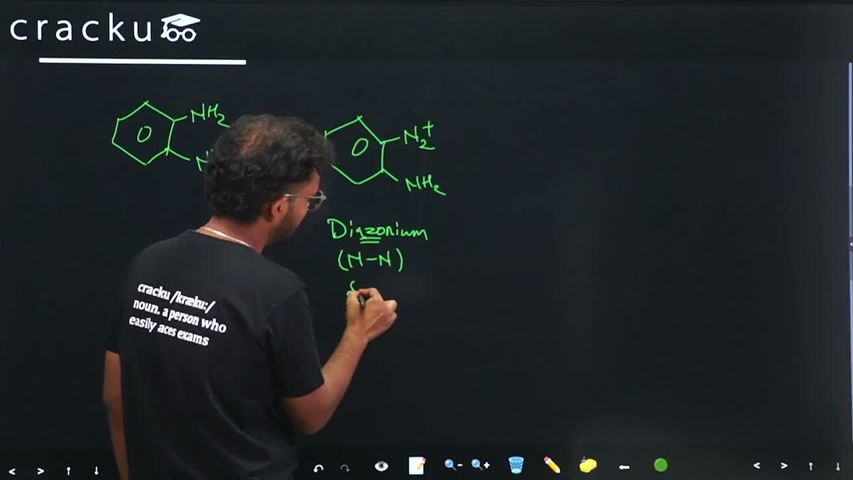
Since o-phenylenediamine has two amino groups ortho to each other, one of the $$-\text{NH}_2$$ groups is converted into a diazonium group ($$-\text{N}_2^+$$).
The adjacent, unreacted primary amino group ($$-\text{NH}_2$$) acts as an internal nucleophile. The lone pair on its nitrogen atom attacks the neighboring diazonium group, causing a rapid intramolecular cyclization to close a stable 5-membered heterocyclic ring.
After losing a proton ($$\text{H}^+$$), the stable heterocyclic compound Benzotriazole is formed.
The resulting compound contains a benzene ring fused to a triazole ring (a 5-membered ring containing three nitrogen atoms), with the structure:
Was this solution helpful?
Click on the Email ☝️ to Watch the Video Solution
Create a FREE account and get:
_1.webp)

Educational materials for JEE preparation

Ask our AI anything

AI can make mistakes. Please verify important information.
AI can make mistakes. Please verify important information.

