
Join Our JEE Preparation Group
Prep with like-minded aspirants; Get access to free daily tests and study material.
Sign in
Please select an account to continue using cracku.in
↓ →
Join Our JEE Preparation Group
Prep with like-minded aspirants; Get access to free daily tests and study material.
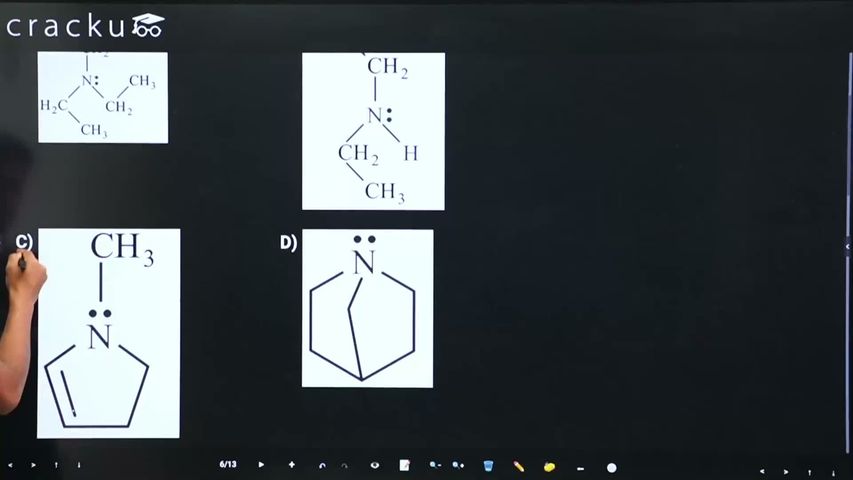
Which among the following is the strongest Bronsted base?
Brønsted basic strength depends on the availability of the nitrogen lone pair for accepting: $$\mathrm{H^+}$$
Basicity is mainly influenced by: $$\mathrm{+I\ effect}$$ and $$\mathrm{Steric\ Hindrance}$$
In: $$\mathrm{N(CH_2CH_3)_3}$$ (triethylamine), three ethyl groups increase electron density on nitrogen through: $$\mathrm{+I\ effect}$$
However, the bulky ethyl groups create significant steric hindrance around nitrogen, reducing protonation and solvation.
Hence, its basic strength decreases.
In:$$\mathrm{HN(CH_2CH_3)_2}$$ (diethylamine), two ethyl groups provide strong: $$\mathrm{+I\ effect}$$ with much lower steric hindrance.
Thus, secondary amines are generally stronger bases than ordinary tertiary amines in aqueous medium.
In: $$\mathrm{1\text{-}Methyl\text{-}3\text{-}pyrroline}$$ the adjacent: $$\mathrm{sp^2}$$ hybridised carbon atoms exert a slight: $$\mathrm{-I\ effect}$$
which decreases electron density on nitrogen. Hence, it is less basic than saturated aliphatic amines.
In: $$\mathrm{Quinuclidine}$$ the nitrogen lone pair is highly available. The bicyclic cage structure provides strong $$\mathrm{+I\ effect}$$ while preventing steric crowding around the lone pair.
Thus, protonation occurs very easily and the conjugate acid formed is highly stable.
Therefore, the strongest Brønsted base is:
$$\mathrm{Quinuclidine}$$
Correct option:
$$\mathrm{D}$$
Was this solution helpful?
Click on the Email ☝️ to Watch the Video Solution
Create a FREE account and get:
_1.webp)

Educational materials for JEE preparation

Ask our AI anything

AI can make mistakes. Please verify important information.
AI can make mistakes. Please verify important information.
