
Join Our JEE Preparation Group
Prep with like-minded aspirants; Get access to free daily tests and study material.
Sign in
Please select an account to continue using cracku.in
↓ →
Join Our JEE Preparation Group
Prep with like-minded aspirants; Get access to free daily tests and study material.
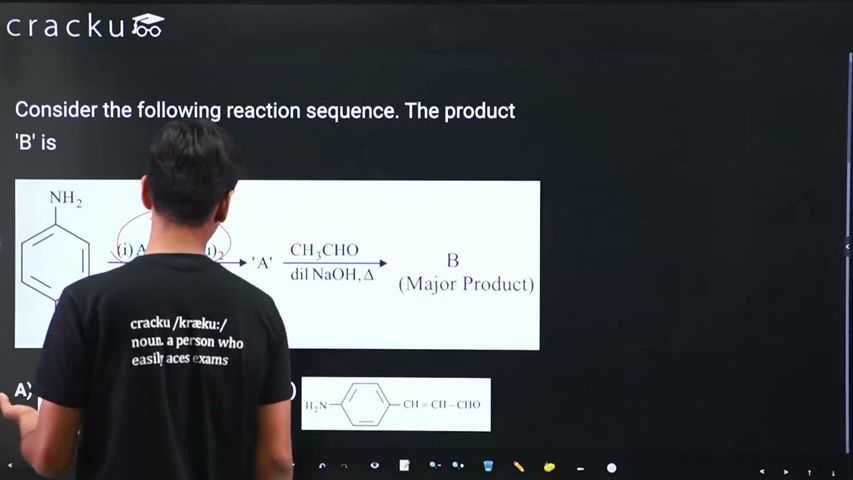
Consider the following reaction sequence. The product 'B' is
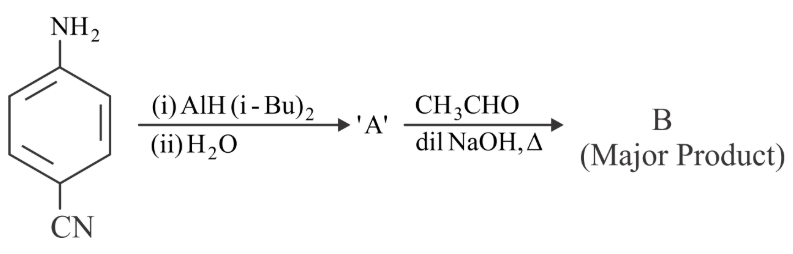
The starting compound is:
$$\mathrm{p\text{-}Aminobenzonitrile}$$
It reacts with:
$$\mathrm{DIBAL\text{-}H}$$
followed by hydrolysis.
DIBAL-H selectively reduces the nitrile group:
$$\mathrm{-CN}$$
to an aldehyde.
$$\mathrm{H_2N-C_6H_4-CN \xrightarrow[DIBAL\text{-}H]{H_2O} H_2N-C_6H_4-CHO}$$
Thus, compound $$\mathrm{A}$$ is:
$$\mathrm{p\text{-}Aminobenzaldehyde}$$
Compound $$\mathrm{A}$$ then reacts with acetaldehyde:
$$\mathrm{CH_3CHO}$$
in presence of:
$$\mathrm{NaOH/\Delta}$$
This is a:
$$\mathrm{Cross\ Aldol\ Condensation}$$
Compound $$\mathrm{A}$$ has no:
$$\mathrm{\alpha\text{-}hydrogen}$$
Hence, it acts only as the electrophile.
Acetaldehyde possesses:
$$\mathrm{\alpha\text{-}hydrogens}$$
and forms an enolate ion.
The enolate attacks the carbonyl carbon of compound $$\mathrm{A}$$.
Subsequent dehydration forms an:
$$\mathrm{\alpha,\beta\text{-}unsaturated\ aldehyde}$$
The final product $$\mathrm{B}$$ is:
$$\mathrm{H_2N-C_6H_4-CH=CH-CHO}$$
Correct option:
$$\mathrm{B}$$
Was this solution helpful?
Click on the Email ☝️ to Watch the Video Solution
Create a FREE account and get:
_1.webp)

Educational materials for JEE preparation

Ask our AI anything

AI can make mistakes. Please verify important information.
AI can make mistakes. Please verify important information.
