
Join Our JEE Preparation Group
Prep with like-minded aspirants; Get access to free daily tests and study material.
Sign in
Please select an account to continue using cracku.in
↓ →
Join Our JEE Preparation Group
Prep with like-minded aspirants; Get access to free daily tests and study material.
The radius of a calcium ion is $$94$$ pm and of the oxide ion is $$146$$ pm. The possible crystal structure of calcium oxide will be
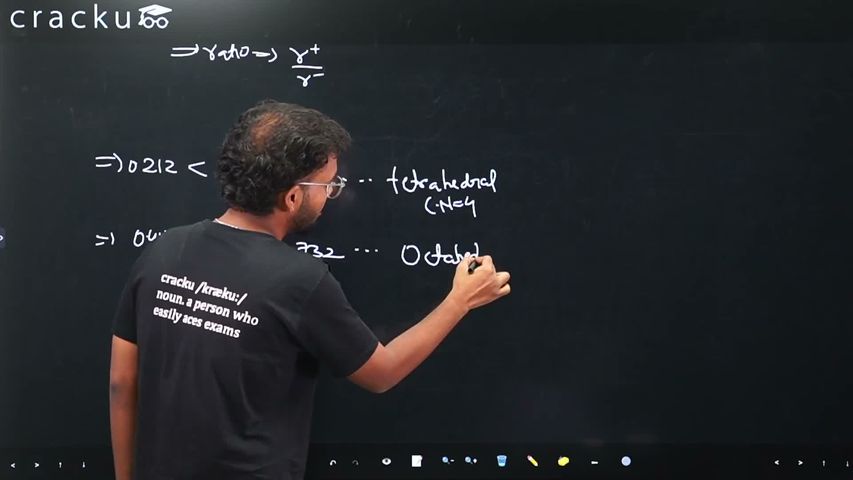
The type of void that a cation occupies in an ionic solid is predicted from the radius-ratio rule.
Define the radius ratio as
$$\text{radius ratio } = \frac{r_{+}}{r_{-}}$$
where $$r_{+}$$ is the radius of the cation and $$r_{-}$$ is the radius of the anion.
For calcium oxide we are given
$$r_{+} \,(Ca^{2+}) = 94 \text{ pm}, \quad r_{-} \,(O^{2-}) = 146 \text{ pm}$$
Calculate the radius ratio:
$$\frac{r_{+}}{r_{-}} = \frac{94}{146} \approx 0.644$$
Now recall the standard radius-ratio ranges:
The computed value $$0.644$$ lies in the interval $$0.414 \lt 0.644 \lt 0.732$$, corresponding to an octahedral void.
Therefore each $$Ca^{2+}$$ is surrounded by six $$O^{2-}$$ ions (and vice versa), giving the NaCl-type (rock-salt) lattice where the coordination number is 6 : 6, i.e., octahedral coordination.
Option C which is: octahedral.
Was this solution helpful?
Click on the Email ☝️ to Watch the Video Solution
Create a FREE account and get:
_1.webp)

Educational materials for JEE preparation

Ask our AI anything

AI can make mistakes. Please verify important information.
AI can make mistakes. Please verify important information.
