
Join Our JEE Preparation Group
Prep with like-minded aspirants; Get access to free daily tests and study material.
Sign in
Please select an account to continue using cracku.in
↓ →
Join Our JEE Preparation Group
Prep with like-minded aspirants; Get access to free daily tests and study material.
In some of the following questions information ( A new rule, a new equation…) required to answer the questions is provided. Read the information provided carefully and answer the following question. The questions can be answered by proper appreciation of the information provided
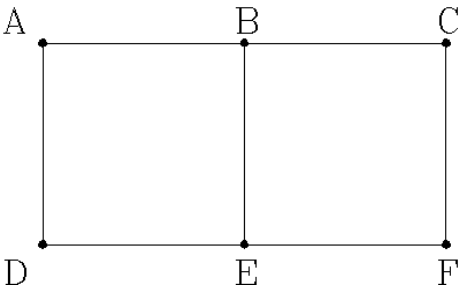
Between any two adjacent junctions the resistance of a wire frame shown is same. If the resistance between B and E is R, resistance between A and B is ______.
Correct Answer: 0
The frame has two squares ABED and BCFE, so seven equal resistors $$r$$. Between B and E, the wire BE is in parallel with the paths BADE and BCFE, each $$3r$$, so $$\frac{1}{R} = \frac{1}{r} + \frac{1}{3r} + \frac{1}{3r} = \frac{5}{3r}$$ and $$r = \frac{5R}{3}$$. Between A and B, setting $$V_A = 1$$ and $$V_B = 0$$ and applying Kirchhoff's current law at C, D, E and F gives $$V_C = \frac{1}{11}$$, $$V_D = \frac{7}{11}$$, $$V_E = \frac{3}{11}$$ and $$V_F = \frac{2}{11}$$. The current leaving A is $$\frac{1}{r}\left(1 + \frac{4}{11}\right) = \frac{15}{11r}$$, so $$R_{AB} = \frac{11r}{15} = \frac{11}{15} \times \frac{5R}{3} = \frac{11R}{9}$$.
Was this solution helpful?


Predict your JEE Main percentile, rank & performance in seconds

Educational materials for JEE preparation

Ask our AI anything

AI can make mistakes. Please verify important information.
AI can make mistakes. Please verify important information.