
Join Our JEE Preparation Group
Prep with like-minded aspirants; Get access to free daily tests and study material.
Sign in
Please select an account to continue using cracku.in
↓ →
Join Our JEE Preparation Group
Prep with like-minded aspirants; Get access to free daily tests and study material.
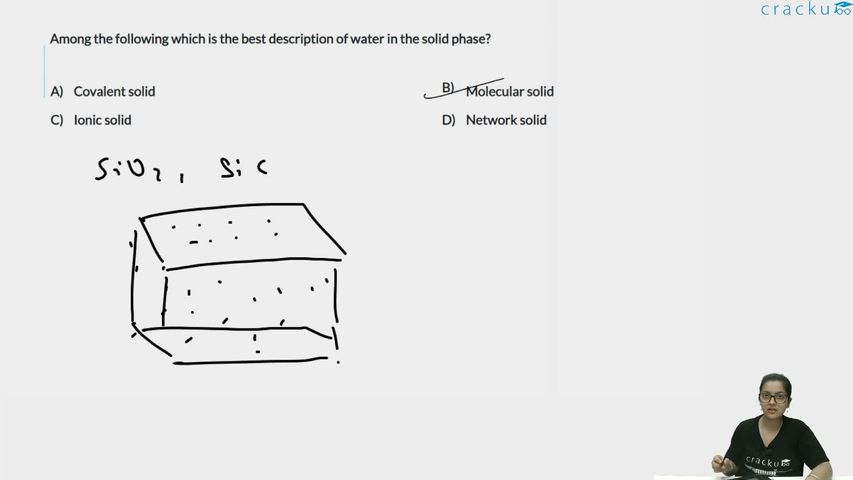
Among the following which is the best description of water in the solid phase?
In the solid state (ice), the fundamental repeating units are discrete $$H_2O$$ molecules.
These $$H_2O$$ molecules are held together in the lattice primarily by hydrogen bonds, which are a type of strong intermolecular force but NOT true covalent bonds extending throughout the crystal.
Classification of crystalline solids:
• Covalent (network) solids - a giant three-dimensional network of atoms joined by covalent bonds (e.g., diamond, $$SiO_2$$).
• Ionic solids - lattice points occupied by cations and anions held by electrostatic forces (e.g., $$NaCl$$).
• Molecular solids - lattice points occupied by neutral molecules held by van der Waals forces, dipole-dipole forces or hydrogen bonds (e.g., $$CO_2$$ (dry ice), ice).
• Metallic solids - lattice of positive ions in a sea of delocalised electrons.
Because ice consists of neutral $$H_2O$$ molecules held by hydrogen bonding, it fits the definition of a molecular solid.
The other options do not apply:
• Option A (covalent solid) and D (network solid) require an extended covalent network, which ice does not possess.
• Option C (ionic solid) would require ions such as $$Na^+$$, $$Cl^-$$, etc., which are absent in pure ice.
Hence, the best description is:
Option B which is: Molecular solid
Was this solution helpful?
Click on the Email ☝️ to Watch the Video Solution
Create a FREE account and get:
_1.webp)

Educational materials for JEE preparation

Ask our AI anything

AI can make mistakes. Please verify important information.
AI can make mistakes. Please verify important information.


