
Join Our JEE Preparation Group
Prep with like-minded aspirants; Get access to free daily tests and study material.
Sign in
Please select an account to continue using cracku.in
↓ →
Join Our JEE Preparation Group
Prep with like-minded aspirants; Get access to free daily tests and study material.
In the photoelectric experiment, if we use a monochromatic light, the $$I\text{-}V$$ curve is as shown. If the work function of the metal is $$2\ \mathrm{eV}$$, estimate the power of light used.
(Assume efficiency of photo emission = $$10^{-3}\%$$, i.e. the number of photoelectrons emitted are $$10^{-3}\%$$ of the number of photons incident on the metal.)
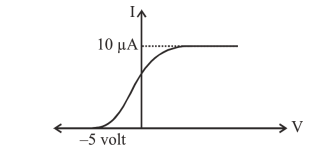
The stopping potential gives the maximum kinetic energy of the photoelectrons: $$K_{\max}=eV_0$$
From the graph, $$V_0=5\,V$$
Hence, $$K_{\max}=5\,eV$$
Using Einstein's photoelectric equation, $$h\nu=\phi+K_{\max}$$
Given, $$\phi=2\,eV$$
Therefore, $$h\nu=2+5=7\,eV$$
Now, the saturation current is due to the photoelectrons emitted per second.
If $$n$$ is the number of incident photons per second, then due to the efficiency, $$n_e=10^{-5}n$$
Therefore, $$I_s=en_e=e(10^{-5}n)$$
Given, $$I_s=10\,\mu A=10^{-5}\,A$$
Thus, $$10^{-5}=e(10^{-5})n$$
$$n=\frac{1}{e}$$
The power of incident light is $$P=nh\nu$$
Since, $$h\nu=7\,eV=7e\,J$$
we get $$P=\frac{1}{e}\times7e$$
$$P=7\,W$$
Therefore, $${P=7\,W}$$
Hence, the correct option is B.
Was this solution helpful?
Click on the Email ☝️ to Watch the Video Solution
Create a FREE account and get:
_1.webp)

Educational materials for JEE preparation

Ask our AI anything

AI can make mistakes. Please verify important information.
AI can make mistakes. Please verify important information.
