
Join Our JEE Preparation Group
Prep with like-minded aspirants; Get access to free daily tests and study material.
Sign in
Please select an account to continue using cracku.in
↓ →
Join Our JEE Preparation Group
Prep with like-minded aspirants; Get access to free daily tests and study material.
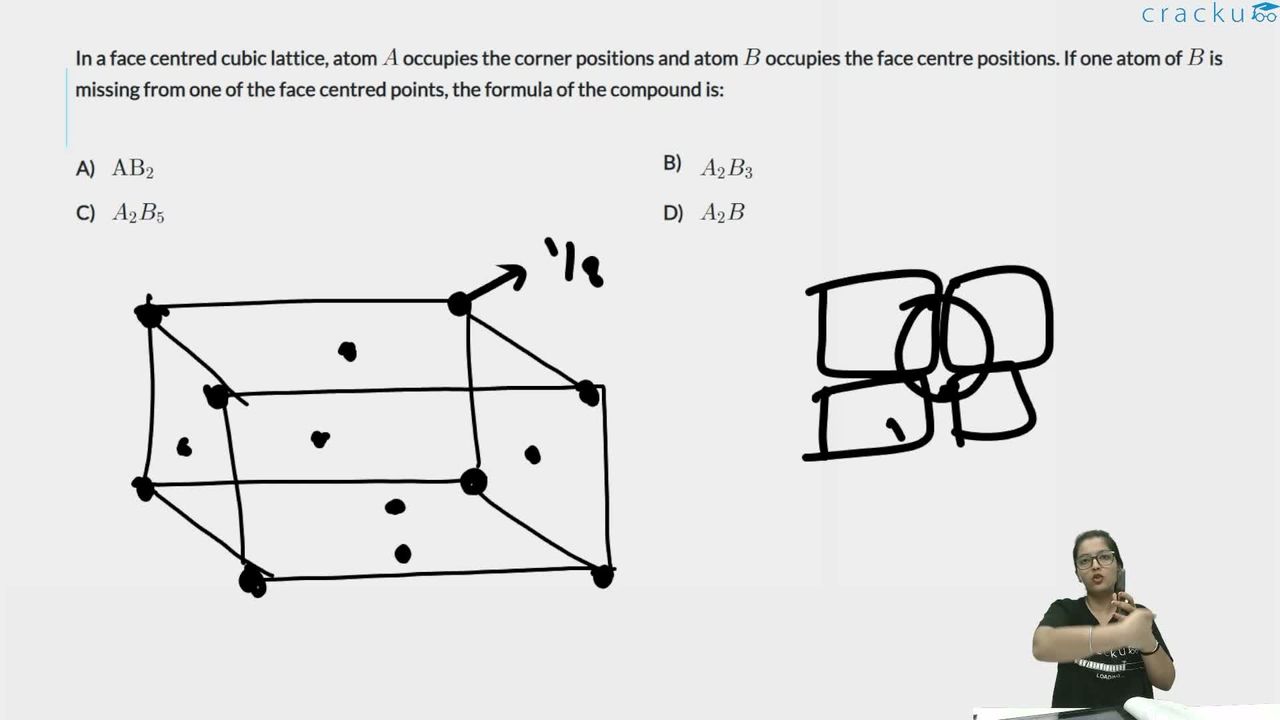
In a face centred cubic lattice, atom $$A$$ occupies the corner positions and atom $$B$$ occupies the face centre positions. If one atom of $$B$$ is missing from one of the face centred points, the formula of the compound is:
In any face-centred cubic (fcc) unit cell:
• There are 8 corner positions. Each corner atom is shared by 8 neighbouring unit cells, so its contribution per unit cell is $$\frac{1}{8}$$.
• There are 6 face-centre positions. Each face-centre atom is shared by 2 neighbouring unit cells, so its contribution per unit cell is $$\frac{1}{2}$$.
Step 1: Atoms of type $$A$$ (present at corners)
Number of corner atoms = 8
Effective number in one unit cell = $$8 \times \frac{1}{8} = 1$$
Step 2: Atoms of type $$B$$ (present at face centres)
Normally there would be 6 face-centre atoms, but the question states that one $$B$$ atom is missing. Hence only 5 faces are occupied.
Effective number of $$B$$ atoms = $$5 \times \frac{1}{2} = 2.5$$
Step 3: Simplest whole-number ratio
Ratio $$A:B = 1 : 2.5$$.
Multiply both numbers by 2 to clear the decimal: $$A:B = 2 : 5$$.
Step 4: Empirical formula
The compound’s formula is $$A_2B_5$$.
Option C which is: $$A_2B_5$$
Was this solution helpful?
Click on the Email ☝️ to Watch the Video Solution
Create a FREE account and get:
_1.webp)

Educational materials for JEE preparation

Ask our AI anything

AI can make mistakes. Please verify important information.
AI can make mistakes. Please verify important information.


