
Join Our JEE Preparation Group
Prep with like-minded aspirants; Get access to free daily tests and study material.
Sign in
Please select an account to continue using cracku.in
↓ →
Join Our JEE Preparation Group
Prep with like-minded aspirants; Get access to free daily tests and study material.
Decreasing order of dehydration of the following alcohols is
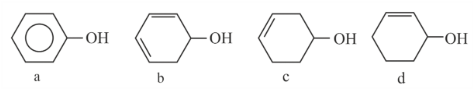
During acid-catalysed dehydration of an alcohol the -OH group is first protonated to give $$R-OH_2^+$$. Loss of $$H_2O$$ then generates a carbocation; the rate-determining step is therefore the formation of this carbocation. Consequently, the ease of dehydration parallels the stability of the carbocation that can be produced.
The four alcohols supplied in the question (written here in a simple text form) are
Case a: $$CH_3CH_2CH_2CH_2OH$$ - 1-butanol (primary, no resonance)Stability of the possible carbocations:
• Tertiary carbocation from (b) is the most stable owing to three electron-releasing alkyl groups (strong +I effect) → highest dehydration rate.
• Allylic carbocation from (d) is resonance-stabilised; although it is formally primary, delocalisation makes it more stable than an ordinary secondary carbocation.
• Secondary carbocation from (c) is stabilised by two alkyl groups but has no resonance.
• Primary carbocation from (a) is the least stable (no resonance, only one +I group) → slowest dehydration.
Therefore, order of stability - and hence the order of ease of dehydration - is
$$\text{(b) tert} \gt \text{(d) allylic} \gt \text{(c) secondary} \gt \text{(a) primary}$$
Hence, the decreasing order of dehydration of the given alcohols is
$$b \; \gt \; d \; \gt \; c \; \gt \; a$$
Option B which is: b > d > c > a
Was this solution helpful?
_1.webp)

Educational materials for JEE preparation

Ask our AI anything

AI can make mistakes. Please verify important information.
AI can make mistakes. Please verify important information.