Join Our JEE Preparation Group
Prep with like-minded aspirants; Get access to free daily tests and study material.
Sign in
Please select an account to continue using cracku.in
↓ →
Join Our JEE Preparation Group
Prep with like-minded aspirants; Get access to free daily tests and study material.
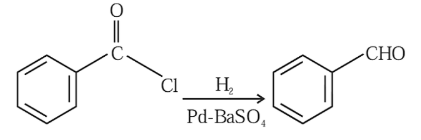
We need to identify the given organic reduction reaction where benzoyl chloride ($$C_6H_5COCl$$) is converted into benzaldehyde ($$C_6H_5CHO$$).
Statement (A): Rosenmund reduction. The Rosenmund reduction is a hydrogenation process where an acyl chloride is selectively reduced to an aldehyde using hydrogen gas ($$H_2$$) over palladium on barium sulfate ($$Pd\text{-}BaSO_4$$). The barium sulfate acts as a catalyst poison to prevent further reduction of the aldehyde into a primary alcohol. This matches the given reaction perfectly. This is TRUE.
Statement (B): Wolff-Kishner reduction. The Wolff-Kishner reduction is used to convert a carbonyl group (aldehyde or ketone) into a methylene group ($$\text{-}CH_2\text{-}$$) using hydrazine ($$NH_2NH_2$$) and a strong base like $$KOH$$. This is FALSE.
Statement (C): Stephen reduction. The Stephen reduction involves the preparation of aldehydes from nitrites ($$R\text{-}CN$$) using tin(II) chloride ($$SnCl_2$$) and hydrochloric acid ($$HCl$$), followed by hydrolysis. This is FALSE.
Statement (D): Etard reduction. The Etard reduction is a reaction that oxidizes an aromatic methyl group to an aldehyde group using chromyl chloride ($$CrO_2Cl_2$$). This is FALSE.
The given reaction represents the Rosenmund reduction.
Answer: Option A — Rosenmund reduction
Was this solution helpful?
Create a FREE account and get:
_1.webp)

Educational materials for JEE preparation

Ask our AI anything

AI can make mistakes. Please verify important information.
AI can make mistakes. Please verify important information.