
Join Our JEE Preparation Group
Prep with like-minded aspirants; Get access to free daily tests and study material.
Sign in
Please select an account to continue using cracku.in
↓ →
Join Our JEE Preparation Group
Prep with like-minded aspirants; Get access to free daily tests and study material.
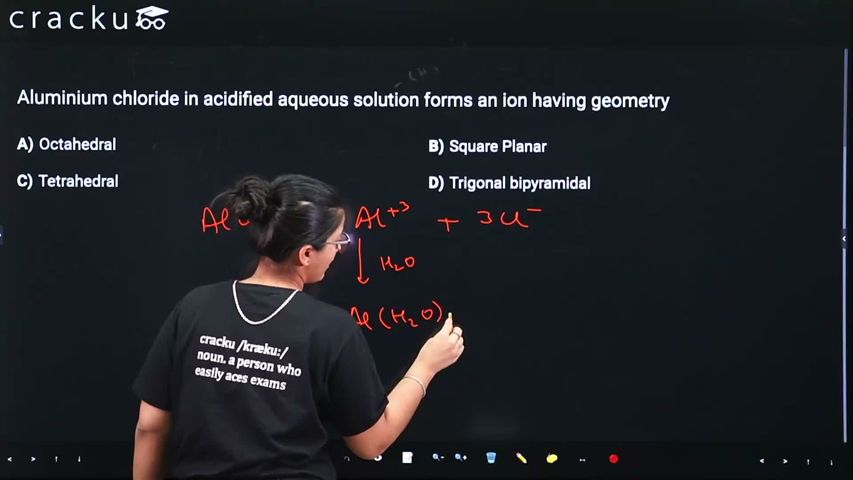
We need to determine the geometry of the ion formed when aluminium chloride is dissolved in acidified aqueous solution.
Key Concept: When $$AlCl_3$$ dissolves in acidified aqueous solution, the $$Al^{3+}$$ ion is strongly hydrated by water molecules due to its high charge density.
In aqueous solution, $$AlCl_3$$ dissociates: $$AlCl_3 \rightarrow Al^{3+} + 3Cl^-$$
The $$Al^{3+}$$ ion, being small and highly charged, coordinates with six water molecules to form the hexaaquaaluminium(III) ion: $$Al^{3+} + 6H_2O \rightarrow [Al(H_2O)_6]^{3+}$$
In the complex $$[Al(H_2O)_6]^{3+}$$, the coordination number of aluminium is 6. With 6 ligands around the central metal ion, the geometry is octahedral.
$$Al^{3+}$$ has the electronic configuration $$[Ne]$$ (or $$1s^2 2s^2 2p^6$$), which has no d-electrons. With sp^3d^2 hybridisation, six water molecules arrange themselves in an octahedral geometry around $$Al^{3+}$$.
Answer: Option 1 — Octahedral
Was this solution helpful?
Click on the Email ☝️ to Watch the Video Solution
Create a FREE account and get:
_1.webp)

Educational materials for JEE preparation

Ask our AI anything

AI can make mistakes. Please verify important information.
AI can make mistakes. Please verify important information.
