
Join Our JEE Preparation Group
Prep with like-minded aspirants; Get access to free daily tests and study material.
Sign in
Please select an account to continue using cracku.in
↓ →
Join Our JEE Preparation Group
Prep with like-minded aspirants; Get access to free daily tests and study material.
The elements Si, Ge, Sn and Pb belong to Group 14 (the carbon family).
For these elements the most common oxidation state is $$+4$$, but a lower oxidation state $$+2$$ is also observed.
Concept used - Inert-pair effect
• As we move down a p-block group, the valence-shell $$ns$$ electron pair is held more tightly (poor shielding of intervening d and f electrons).
• Hence it becomes increasingly difficult to promote these two $$ns$$ electrons into bonding orbitals.
• This reluctance is called the inert-pair effect and it stabilises the lower oxidation state $$+2$$ relative to $$+4$$ for heavier members of the group.
Applying the concept to Group 14:
• For Si the inert-pair effect is negligible, so the $$+4$$ state dominates and $$SiX_2$$ is extremely unstable.
• The effect appears gradually in Ge, becomes significant in Sn and is strongest in Pb.
• Therefore the order of stability of the $$+2$$ halides (dihalides) increases down the group.
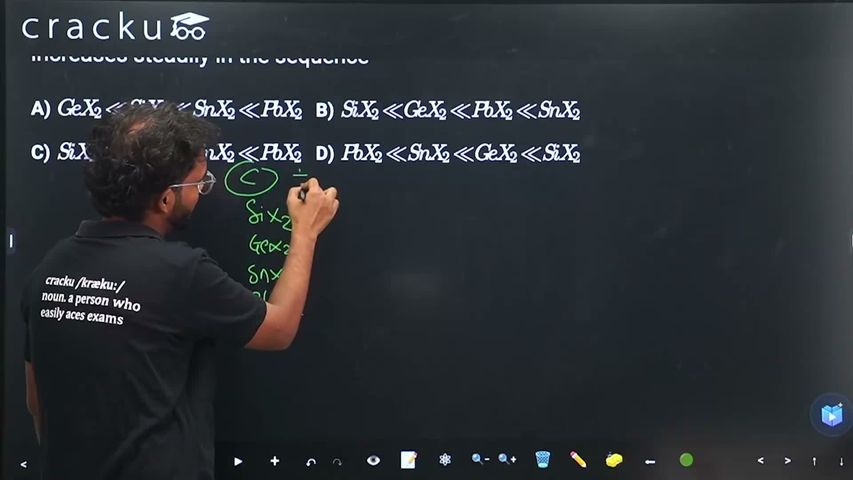
Hence, $$SiX_2 \ll GeX_2 \ll SnX_2 \ll PbX_2$$.
So, the correct option is:
Option C which is: $$SiX_2 \ll GeX_2 \ll SnX_2 \ll PbX_2$$
Was this solution helpful?
Click on the Email ☝️ to Watch the Video Solution
Create a FREE account and get:
_1.webp)

Educational materials for JEE preparation

Ask our AI anything

AI can make mistakes. Please verify important information.
AI can make mistakes. Please verify important information.
