Step 1: Functional Groups in Novestrol
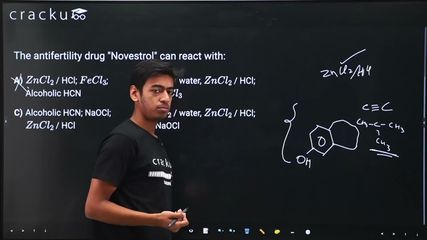
Novestrol contains three primary reactive functional groups:
- A Phenolic Group (-OH attached directly to a benzene ring): Found on the aromatic ring A.
- An Alcohol Group (Secondary/Tertiary -OH): A tertiary hydroxyl group located on ring D.
- A Terminal Alkyne Group (-C triple bond CH): Also located on ring D, adjacent to the tertiary alcohol.
Step 2: Testing Reagents Against the Functional Groups
Let's look at the reagents given in Option B and match them to these functional groups:
- Br2 / water (Bromine Water): * The phenolic ring is highly activated due to the resonance donation from the -OH group.
- When treated with bromine water, it readily undergoes electrophilic aromatic substitution to form a brominated derivative (it can also react with the terminal alkyne group). Therefore, Novestrol gives a positive test with Br2/water.
- ZnCl2 / HCl (Lucas Reagent):
- This reagent is used to distinguish between primary, secondary, and tertiary alcohols based on how fast they form an insoluble alkyl chloride.
- Since Novestrol contains an alcohol functional group, it will react with the Lucas reagent.
- FeCl3 (Neutral Ferric Chloride):
- This is the characteristic diagnostic test for compounds containing a phenolic group.
- Because Novestrol possesses a phenol ring, adding FeCl3 results in a characteristic colored complex formation (usually violet or green/blue), indicating a successful reaction.
Why the Other Options are Incorrect
- Options A and C (Alcoholic HCN): Novestrol does not contain a carbonyl group (like an aldehyde or ketone) or an unhindered electrophilic center that typically undergoes nucleophilic addition with HCN. Thus, it will not react with alcoholic HCN.
- Options C and D (NaOCl): Sodium hypochlorite (NaOCl) is commonly used in haloform reactions for methyl ketones or specific oxidation reactions that do not selectively or characteristically target the key functional groups of Novestrol in this standard testing context.
Was this solution helpful?

_1.webp)



