
Join Our JEE Preparation Group
Prep with like-minded aspirants; Get access to free daily tests and study material.
Sign in
Please select an account to continue using cracku.in
↓ →
Join Our JEE Preparation Group
Prep with like-minded aspirants; Get access to free daily tests and study material.
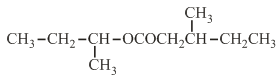
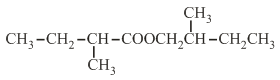
An organic compound [A], molecular formula $$C_{10}H_{20}O_2$$ was hydrolyzed with dilute sulphuric acid to give a carboxylic acid [B] and an alcohol [C]. Oxidation of [C] with $$CrO_3 - H_2SO_4$$ produced [B]. Which of the following structures are not possible for [A]?
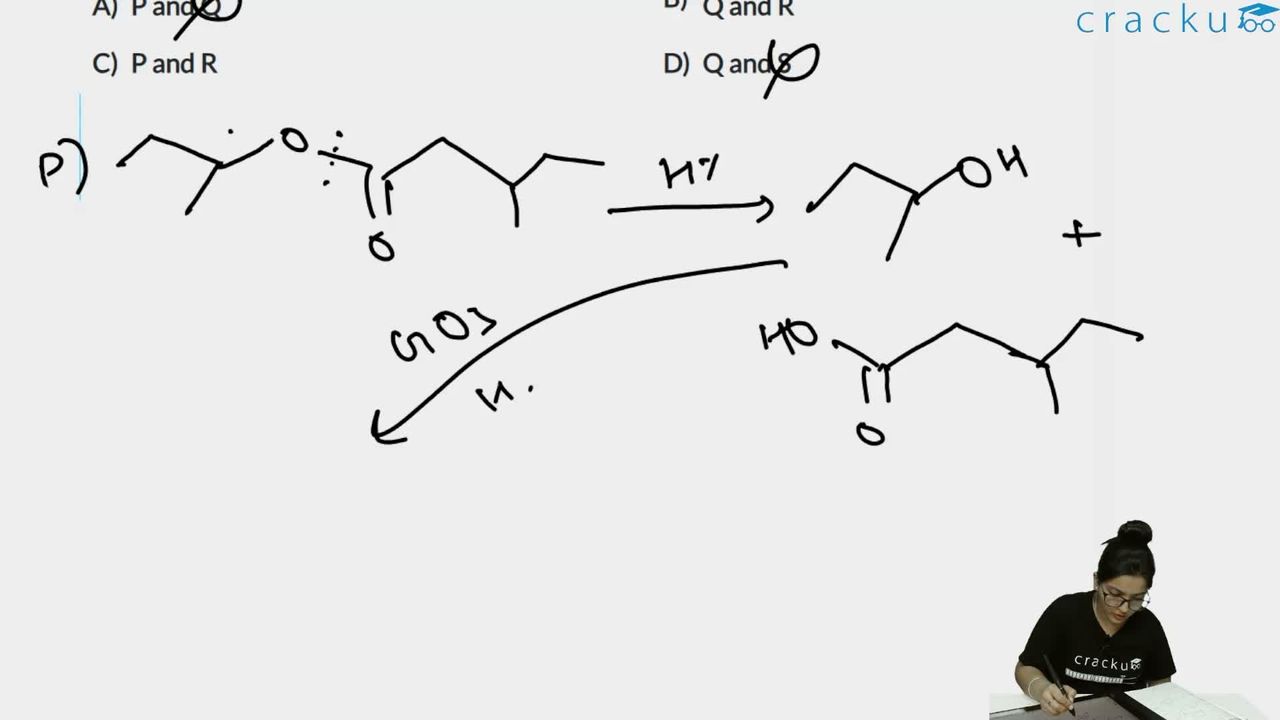
P)
Q)
R) $$CH_3CH_2CH_2COOCH_2CH_2CH_2CH_3$$
S) $$(CH_3)_3 - C - COOCH_2C(CH_3)_3$$
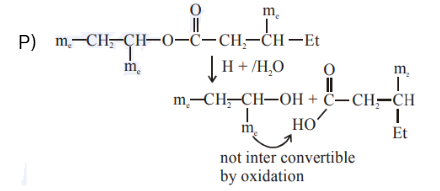
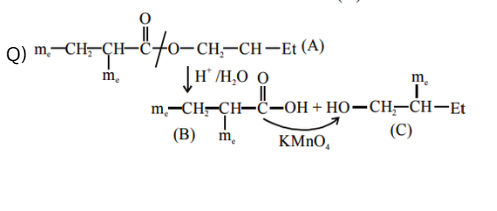
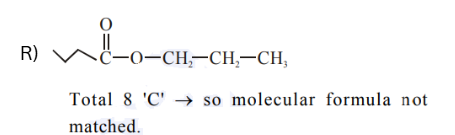
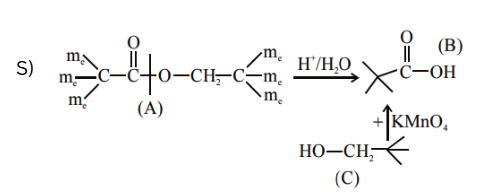
Hydrolysis of Compound [A]:
Compound [A] has the molecular formula $$\text{C}_{10}\text{H}_{20}\text{O}_2$$. Since it undergoes hydrolysis with dilute sulfuric acid ($$\text{H}_2\text{SO}_4$$) to yield a carboxylic acid [B] and an alcohol [C], compound [A] must be an ester.
$$\text{R--COO--R'} \xrightarrow{\text{H}_3\text{O}^+} \text{R--COOH [B]} + \text{R'--OH [C]}$$Oxidation of Alcohol [C]:
Oxidation of alcohol [C] with Jones reagent ($$\text{CrO}_3\text{--H}_2\text{SO}_4$$) produces the exact same carboxylic acid [B]. Jones reagent is a strong oxidizing agent that converts primary alcohols directly into carboxylic acids without altering the carbon framework:
$$\text{R'--OH [C]} \xrightarrow{\text{CrO}_3\text{--H}_2\text{SO}_4} \text{R--COOH [B]}$$This implies that both the acyl part (from the acid) and the alkyl part (from the alcohol) of the ester must contain the same number of carbon atoms with identical connectivity, meaning:
$$\text{Number of Carbon atoms in [B]} = \text{Number of Carbon atoms in [C]} = \frac{10}{2} = 5\text{ carbons}$$Was this solution helpful?
Click on the Email ☝️ to Watch the Video Solution
Create a FREE account and get:
_1.webp)

Educational materials for JEE preparation

Ask our AI anything

AI can make mistakes. Please verify important information.
AI can make mistakes. Please verify important information.
