
Join Our JEE Preparation Group
Prep with like-minded aspirants; Get access to free daily tests and study material.
Sign in
Please select an account to continue using cracku.in
↓ →
Join Our JEE Preparation Group
Prep with like-minded aspirants; Get access to free daily tests and study material.
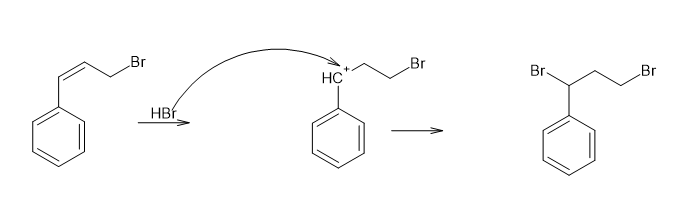
The alkene reacted with $$\text{HBr}$$ acts as a nucleophile and attacks the proton ($$\text{H}^+$$). The double bond breaks to form the most stable possible carbocation intermediate.
The positive charge on the carbon directly attached to the benzene ring is a benzylic carbocation. It is exceptionally stable because the positive charge can be delocalized throughout the $$\pi$$-system of the aromatic ring via resonance.
Once the stable benzylic carbocation intermediate is formed, the bromide ion ($$\text{Br}^-$$) attacks the electron-deficient benzylic carbon.
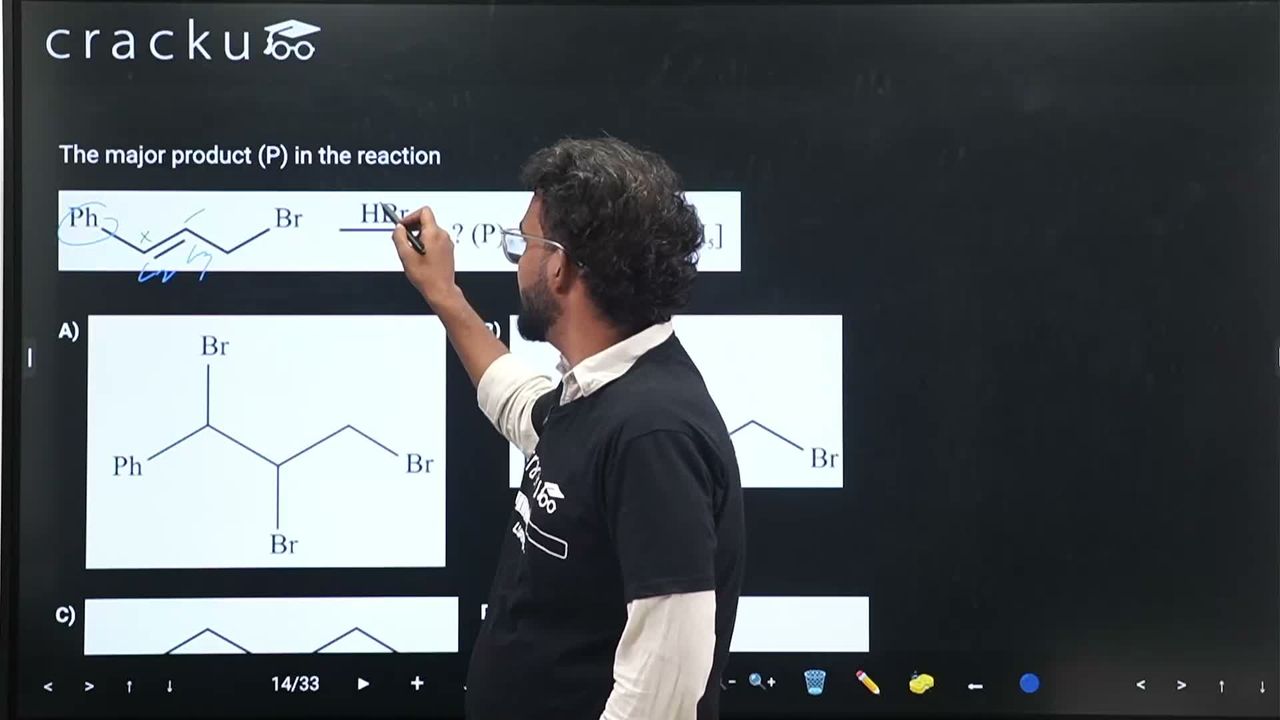
Therefore, Option B is correct
Was this solution helpful?
Click on the Email ☝️ to Watch the Video Solution
Create a FREE account and get:
_1.webp)

Educational materials for JEE preparation

Ask our AI anything

AI can make mistakes. Please verify important information.
AI can make mistakes. Please verify important information.

