
Join Our JEE Preparation Group
Prep with like-minded aspirants; Get access to free daily tests and study material.
Sign in
Please select an account to continue using cracku.in
↓ →
Join Our JEE Preparation Group
Prep with like-minded aspirants; Get access to free daily tests and study material.
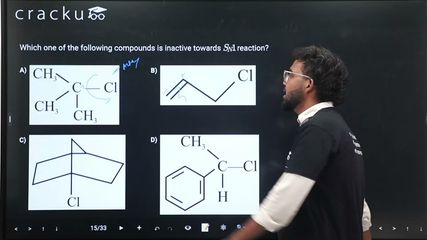
Which one of the following compounds is inactive towards $$S_N1$$ reaction?
The rate-determining step of an SN1 (Substitution Nucleophilic Unimolecular) reaction relies entirely on the loss of a leaving group (like Cl¯) to form a stable carbocation intermediate.
Option C represents a bridged bicyclic compound where the chlorine atom is attached to a bridgehead carbon. Attempting an SN1 pathway on this molecule fails severely due to geometric constraints:
Bredt's Rule states: A double bond or a planar sp2 hybridized center cannot form at a bridgehead position of a small bridged bicyclic system (rings containing fewer than 8 carbons), because the rigid bridge network prevents the carbon from flattening out.
Let's look at why the other molecules given in the question are reactive:
Because forming a carbocation at the bridgehead position in Option C creates immense angle strain that cannot be relieved, the energy barrier to break the C-Cl bond via an SN1 pathway is too high. Thus, it remains completely inert.
Was this solution helpful?
Click on the Email ☝️ to Watch the Video Solution
Create a FREE account and get:
_1.webp)

Educational materials for JEE preparation

Ask our AI anything

AI can make mistakes. Please verify important information.
AI can make mistakes. Please verify important information.
