
Join Our JEE Preparation Group
Prep with like-minded aspirants; Get access to free daily tests and study material.
Sign in
Please select an account to continue using cracku.in
↓ →
Join Our JEE Preparation Group
Prep with like-minded aspirants; Get access to free daily tests and study material.
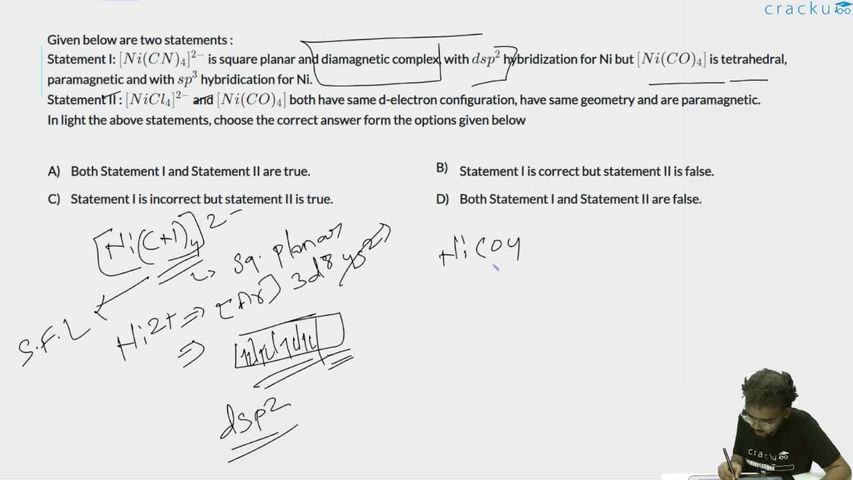
Given below are two statements :
Statement I: $$[Ni(CN)_4]^{2-}$$ is square planar and diamagnetic complex, with $$dsp^2$$ hybridization for Ni but $$[Ni(CO)_4]$$ is tetrahedral, paramagnetic and with $$sp^3$$ hybridication for Ni.
Statement II : $$[NiCl_4]^{2-}$$ and $$[Ni(CO)_4]$$ both have same d-electron configuration, have same geometry and are paramagnetic.
In light the above statements, choose the correct answer form the options given below
We need to evaluate both statements about nickel complexes.
Background: Nickel electronic configuration
$$Ni$$ has atomic number 28: $$[Ar] 3d^8 4s^2$$
$$Ni^{2+}$$: $$[Ar] 3d^8$$ (2 unpaired electrons)
$$Ni^{0}$$: $$[Ar] 3d^8 4s^2$$ (in complexes, effectively $$3d^{10}$$ with strong field ligands)
Analysis of Statement I:
$$[Ni(CN)_4]^{2-}$$:
- $$Ni^{2+}$$ has $$3d^8$$ configuration
- $$CN^-$$ is a strong field ligand, so it forces pairing of electrons
- The two unpaired electrons in $$3d$$ pair up, vacating one 3d orbital
- Hybridization: $$dsp^2$$ → square planar geometry
- All electrons are paired → diamagnetic
This part of Statement I is correct.
$$[Ni(CO)_4]$$:
- $$Ni$$ is in zero oxidation state ($$Ni^0$$): $$[Ar] 3d^{8} 4s^2$$
- $$CO$$ is a very strong field ligand (causes pairing)
- In $$Ni(CO)_4$$, the effective configuration becomes $$3d^{10}$$ as the 4s electrons move to 3d orbitals
- With all 3d orbitals filled, the hybridization is $$sp^3$$ → tetrahedral
- All electrons are paired → $$[Ni(CO)_4]$$ is diamagnetic, NOT paramagnetic
Statement I says $$[Ni(CO)_4]$$ is paramagnetic, which is wrong.
Therefore, Statement I is FALSE.
Analysis of Statement II:
$$[NiCl_4]^{2-}$$:
- $$Ni^{2+}$$: $$3d^8$$ (2 unpaired electrons)
- $$Cl^-$$ is a weak field ligand → no pairing of electrons
- Hybridization: $$sp^3$$ → tetrahedral geometry
- Has 2 unpaired electrons → paramagnetic
$$[Ni(CO)_4]$$:
- As analyzed above: $$3d^{10}$$ configuration
- $$sp^3$$ → tetrahedral geometry
- All electrons paired → diamagnetic
Statement II claims both have the same d-electron configuration, same geometry, and are both paramagnetic.
- d-electron configurations are different: $$3d^8$$ ($$Ni^{2+}$$) vs $$3d^{10}$$ ($$Ni^0$$)
- Both are tetrahedral (same geometry) — this is correct
- $$[Ni(CO)_4]$$ is diamagnetic, not paramagnetic — this is wrong
Therefore, Statement II is also FALSE.
The correct answer is Option D: Both Statement I and Statement II are false.
Was this solution helpful?
Click on the Email ☝️ to Watch the Video Solution
Create a FREE account and get:
_1.webp)

Educational materials for JEE preparation

Ask our AI anything

AI can make mistakes. Please verify important information.
AI can make mistakes. Please verify important information.
