Join Our JEE Preparation Group
Prep with like-minded aspirants; Get access to free daily tests and study material.
Sign in
Please select an account to continue using cracku.in
↓ →
Join Our JEE Preparation Group
Prep with like-minded aspirants; Get access to free daily tests and study material.
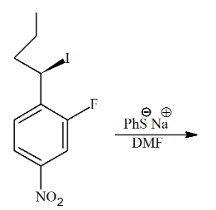
The substrate contains two possible leaving groups: an alkyl iodide and an aryl fluoride.
Sodium thiophenoxide $$\mathrm{(PhS^-Na^+)}$$ acts as a strong nucleophile, and DMF is a polar aprotic solvent that strongly favors $$\mathrm{S_N2}$$ reactions.
The alkyl iodide undergoes substitution much more readily because $$\mathrm{I^-}$$ is an excellent leaving group, whereas nucleophilic aromatic substitution on the fluoronitrobenzene ring is comparatively less favorable under these conditions.
Thus, $$\mathrm{PhS^-}$$ attacks the carbon bearing iodine via backside attack through an $$\mathrm{S_N2}$$ mechanism.
Since $$\mathrm{S_N2}$$ reactions proceed with inversion of configuration, the incoming $$\mathrm{-SPh}$$ group appears on the side opposite to the original iodine substituent.
The aromatic ring and its substituents remain unchanged.
Hence, the correct product is the one showing $$\mathrm{-SPh}$$ on a dashed bond due to inversion of stereochemistry.
Was this solution helpful?
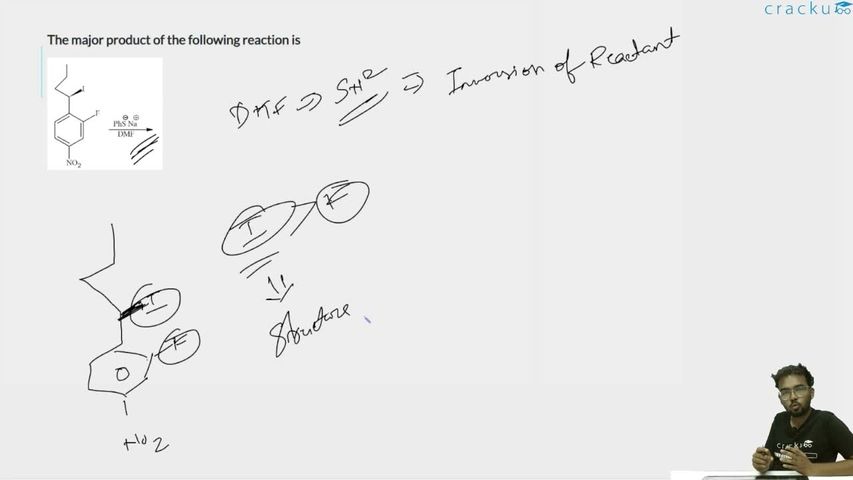
Click on the Email ☝️ to Watch the Video Solution
Create a FREE account and get:
_1.webp)

Educational materials for JEE preparation

Ask our AI anything

AI can make mistakes. Please verify important information.
AI can make mistakes. Please verify important information.