Join Our JEE Preparation Group
Prep with like-minded aspirants; Get access to free daily tests and study material.
Sign in
Please select an account to continue using cracku.in
↓ →
Join Our JEE Preparation Group
Prep with like-minded aspirants; Get access to free daily tests and study material.
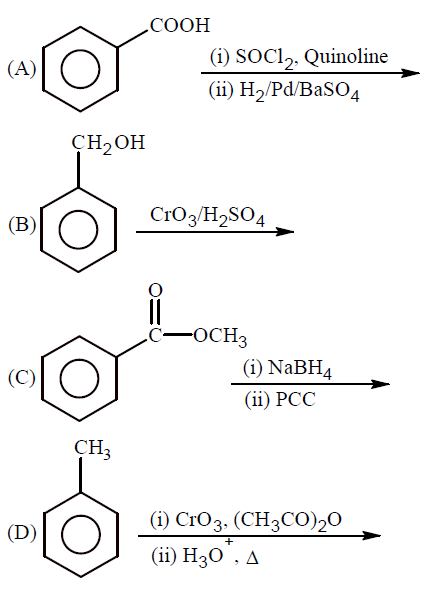
To determine which reactions produce benzaldehyde, the reagents and reaction conditions must be analysed.
In reaction $$\mathrm{(A)}$$, benzoic acid first reacts with $$\mathrm{SOCl_2}$$ to form benzoyl chloride.
Subsequent treatment with $$\mathrm{H_2/Pd/BaSO_4}$$ performs the:
$$\mathrm{Rosenmund\ Reduction}$$
which selectively converts the acid chloride into benzaldehyde.
Hence, reaction $$\mathrm{(A)}$$ gives benzaldehyde.
In reaction $$\mathrm{(B)}$$, benzyl alcohol reacts with $$\mathrm{CrO_3/H_2SO_4}$$ (Jones reagent).
This strong oxidising agent converts the primary alcohol completely into benzoic acid.
Hence, benzaldehyde is not obtained.
In reaction $$\mathrm{(C)}$$, methyl benzoate is treated with $$\mathrm{NaBH_4}$$.
$$\mathrm{NaBH_4}$$ is too mild to reduce esters.
Therefore, no aldehyde is formed and PCC has no effect.
Hence, benzaldehyde is not obtained.
In reaction $$\mathrm{(D)}$$, toluene reacts with $$\mathrm{CrO_3/(CH_3CO)_2O}$$ to form a protected gem-diacetate intermediate.
Acid hydrolysis using $$\mathrm{H_3O^+,\ \Delta}$$ converts this intermediate into benzaldehyde.
Hence, reaction $$\mathrm{(D)}$$ gives benzaldehyde.
Therefore, the reactions producing benzaldehyde are: $$\mathrm{(A)\ and\ (D)}$$
Thus, the right option is C.
Was this solution helpful?
Click on the Email ☝️ to Watch the Video Solution
Create a FREE account and get:
_1.webp)

Educational materials for JEE preparation

Ask our AI anything

AI can make mistakes. Please verify important information.
AI can make mistakes. Please verify important information.