
Join Our JEE Preparation Group
Prep with like-minded aspirants; Get access to free daily tests and study material.
Sign in
Please select an account to continue using cracku.in
↓ →
Join Our JEE Preparation Group
Prep with like-minded aspirants; Get access to free daily tests and study material.
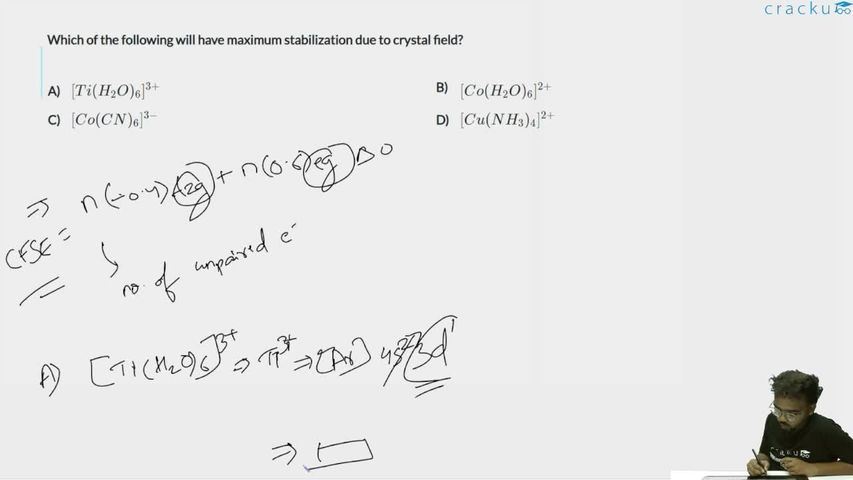
Which of the following will have maximum stabilization due to crystal field?
Crystal field stabilization energy (CFSE) determines the stabilization of a complex. We need to find which complex has the maximum CFSE.
Option A: $$[Ti(H_2O)_6]^{3+}$$
$$Ti^{3+}$$ has configuration $$3d^1$$. $$H_2O$$ is a weak field ligand, so octahedral splitting gives:
$$t_{2g}^1 e_g^0$$
CFSE = $$-0.4\Delta_o$$
Option B: $$[Co(H_2O)_6]^{2+}$$
$$Co^{2+}$$ has configuration $$3d^7$$. $$H_2O$$ is a weak field ligand (high spin):
$$t_{2g}^5 e_g^2$$
CFSE = $$5(-0.4) + 2(0.6) = -0.8\Delta_o$$
Option C: $$[Co(CN)_6]^{3-}$$
$$Co^{3+}$$ has configuration $$3d^6$$. $$CN^-$$ is a strong field ligand (low spin):
$$t_{2g}^6 e_g^0$$
CFSE = $$6(-0.4)\Delta_o = -2.4\Delta_o$$
Additionally, $$Co^{3+}$$ has a higher charge than $$Co^{2+}$$ or $$Ti^{3+}$$, and $$CN^-$$ causes a much larger crystal field splitting ($$\Delta_o$$) compared to $$H_2O$$ or $$NH_3$$. The actual CFSE in absolute terms is very large.
Option D: $$[Cu(NH_3)_4]^{2+}$$
$$Cu^{2+}$$ has configuration $$3d^9$$. This is a square planar complex:
CFSE for $$d^9$$ in square planar geometry is relatively moderate.
Comparing all options, $$[Co(CN)_6]^{3-}$$ has the maximum CFSE because:
1. $$Co^{3+}$$ ($$d^6$$) with strong field $$CN^-$$ ligand forms a low spin complex with all 6 electrons in $$t_{2g}$$.
2. The coefficient is $$-2.4\Delta_o$$, the highest among the options.
3. $$CN^-$$ produces a very large $$\Delta_o$$.
Hence, the correct answer is Option C.
Was this solution helpful?
Click on the Email ☝️ to Watch the Video Solution
Create a FREE account and get:
_1.webp)

Educational materials for JEE preparation

Ask our AI anything

AI can make mistakes. Please verify important information.
AI can make mistakes. Please verify important information.
