Join Our JEE Preparation Group
Prep with like-minded aspirants; Get access to free daily tests and study material.
Sign in
Please select an account to continue using cracku.in
↓ →
Join Our JEE Preparation Group
Prep with like-minded aspirants; Get access to free daily tests and study material.
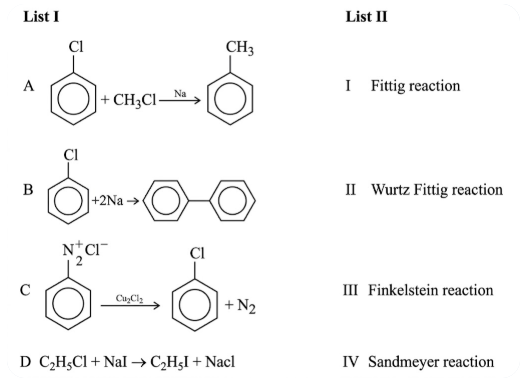
In Reaction A, chlorobenzene reacts with methyl chloride in the presence of sodium metal to form toluene. This involves the coupling of an aryl halide with an alkyl halide and is the Wurtz-Fittig reaction.
$$\boxed{\text{A} \rightarrow \text{II (Wurtz-Fittig reaction)}}$$
In Reaction B, two molecules of chlorobenzene couple in the presence of sodium metal to form diphenyl. This is the Fittig reaction, which involves the coupling of two aryl halides.
$$\boxed{\text{B} \rightarrow \text{I (Fittig reaction)}}$$
In Reaction C, benzenediazonium chloride reacts with cuprous chloride ((Cu_2Cl_2)) to give chlorobenzene by replacement of the diazonium group. This is the Sandmeyer reaction.
$$\boxed{\text{C} \rightarrow \text{IV (Sandmeyer reaction)}}$$
In Reaction D, ethyl chloride reacts with sodium iodide to form ethyl iodide through halogen exchange. This reaction is known as the Finkelstein reaction.
$$\boxed{\text{D} \rightarrow \text{III (Finkelstein reaction)}}$$
Hence, the correct matching is
$$\boxed{\text{A-II,; B-I,; C-IV,; D-III}}.$$
Was this solution helpful?
Click on the Email ☝️ to Watch the Video Solution
Create a FREE account and get:
_1.webp)

Educational materials for JEE preparation

Ask our AI anything

AI can make mistakes. Please verify important information.
AI can make mistakes. Please verify important information.