
Join Our JEE Preparation Group
Prep with like-minded aspirants; Get access to free daily tests and study material.
Sign in
Please select an account to continue using cracku.in
↓ →
Join Our JEE Preparation Group
Prep with like-minded aspirants; Get access to free daily tests and study material.
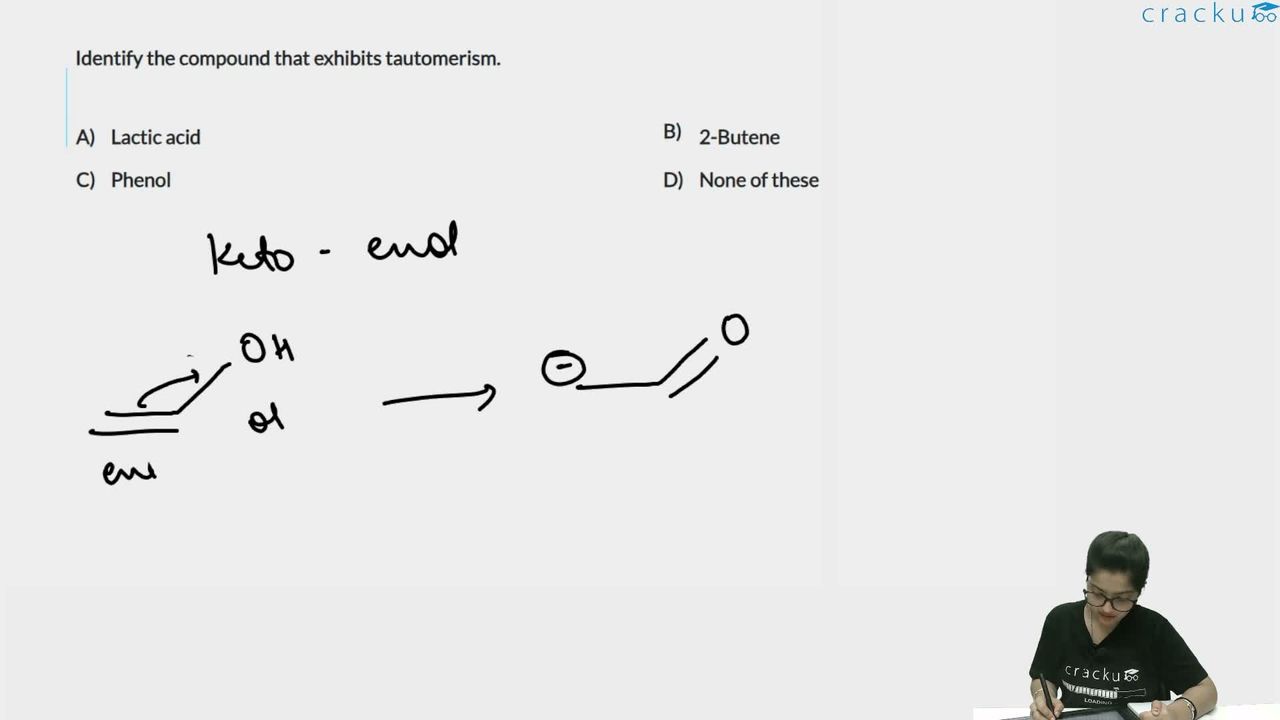
Tautomerism is a special type of isomerism in which two constitutional isomers (tautomers) are inter-convertible by the migration of a proton accompanied by a shift of a double bond. The most common category is keto-enol tautomerism, which requires:
• a carbon-oxygen double bond (C=O) or equivalent electron-rich π-system
• at least one $$\alpha$$-hydrogen that can migrate to the oxygen atom.
Case A: Lactic acid, $$CH_3CH(OH)COOH$$
Lactic acid contains a carboxylic acid group. In carboxylic acids, the carbonyl carbon is part of the -COOH system, and the acidic hydrogen already resides on the hydroxyl oxygen. Migration of an $$\alpha$$-H to form an enol is not favorable because resonance stabilization of the -COOH group is lost. Hence lactic acid does not show keto-enol tautomerism.
Case B: 2-Butene, $$CH_3CH = CHCH_3$$
2-Butene is an alkene; it has no carbonyl group. Without a C=O bond, the essential keto-enol framework is absent, so tautomerism is impossible.
Case C: Phenol, $$C_6H_5OH$$
Phenol is an enol (aromatic enol). It can tautomerise to its keto form, cyclohexadienone:
$$\text{Phenol (enol)} \;\;\rightleftharpoons\;\; \text{Cyclohexadienone (keto)}$$
The equilibrium lies far to the left (phenol side) because the aromatic sextet is lost on forming the keto tautomer, yet the existence of the keto form—even in trace amounts—qualifies phenol as a compound that exhibits tautomerism.
Case D: None of these
Since phenol does show tautomerism, the option “None of these” is incorrect.
Therefore, the compound that exhibits tautomerism is:
Option C which is: Phenol
Was this solution helpful?
Click on the Email ☝️ to Watch the Video Solution
Create a FREE account and get:
_1.webp)

Educational materials for JEE preparation

Ask our AI anything

AI can make mistakes. Please verify important information.
AI can make mistakes. Please verify important information.


