
Join Our JEE Preparation Group
Prep with like-minded aspirants; Get access to free daily tests and study material.
Sign in
Please select an account to continue using cracku.in
↓ →
Join Our JEE Preparation Group
Prep with like-minded aspirants; Get access to free daily tests and study material.
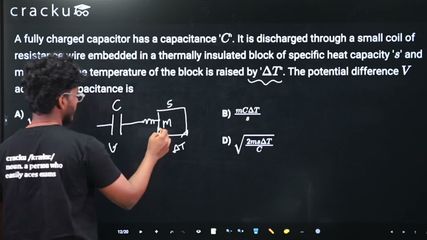
A fully charged capacitor has a capacitance '$$C$$'. It is discharged through a small coil of resistance wire embedded in a thermally insulated block of specific heat capacity '$$s$$' and mass '$$m$$'. If the temperature of the block is raised by '$$\Delta T$$'. The potential difference $$V$$ across the capacitance is
By the principle of conservation of energy, since the block is thermally insulated, the total electrical energy stored in the fully charged capacitor is completely dissipated as heat across the resistance wire, which is then absorbed by the block.
The initial electrical energy stored in the capacitor is:
$$ E = \frac{1}{2} C V^2 $$
The heat energy gained by the block to raise its temperature by $$\Delta T$$ is given by the calorimetry formula:
$$ Q = m s \Delta T $$
Equating the electrical energy dissipated to the heat energy absorbed ($$E = Q$$):
$$ \frac{1}{2} C V^2 = m s \Delta T $$
Now, solve for the potential difference $$V$$:
$$ V^2 = \frac{2 m s \Delta T}{C} $$
$$ V = \sqrt{\frac{2 m s \Delta T}{C}} $$
Was this solution helpful?
Click on the Email ☝️ to Watch the Video Solution
Create a FREE account and get:
_1.webp)

Educational materials for JEE preparation

Ask our AI anything

AI can make mistakes. Please verify important information.
AI can make mistakes. Please verify important information.
